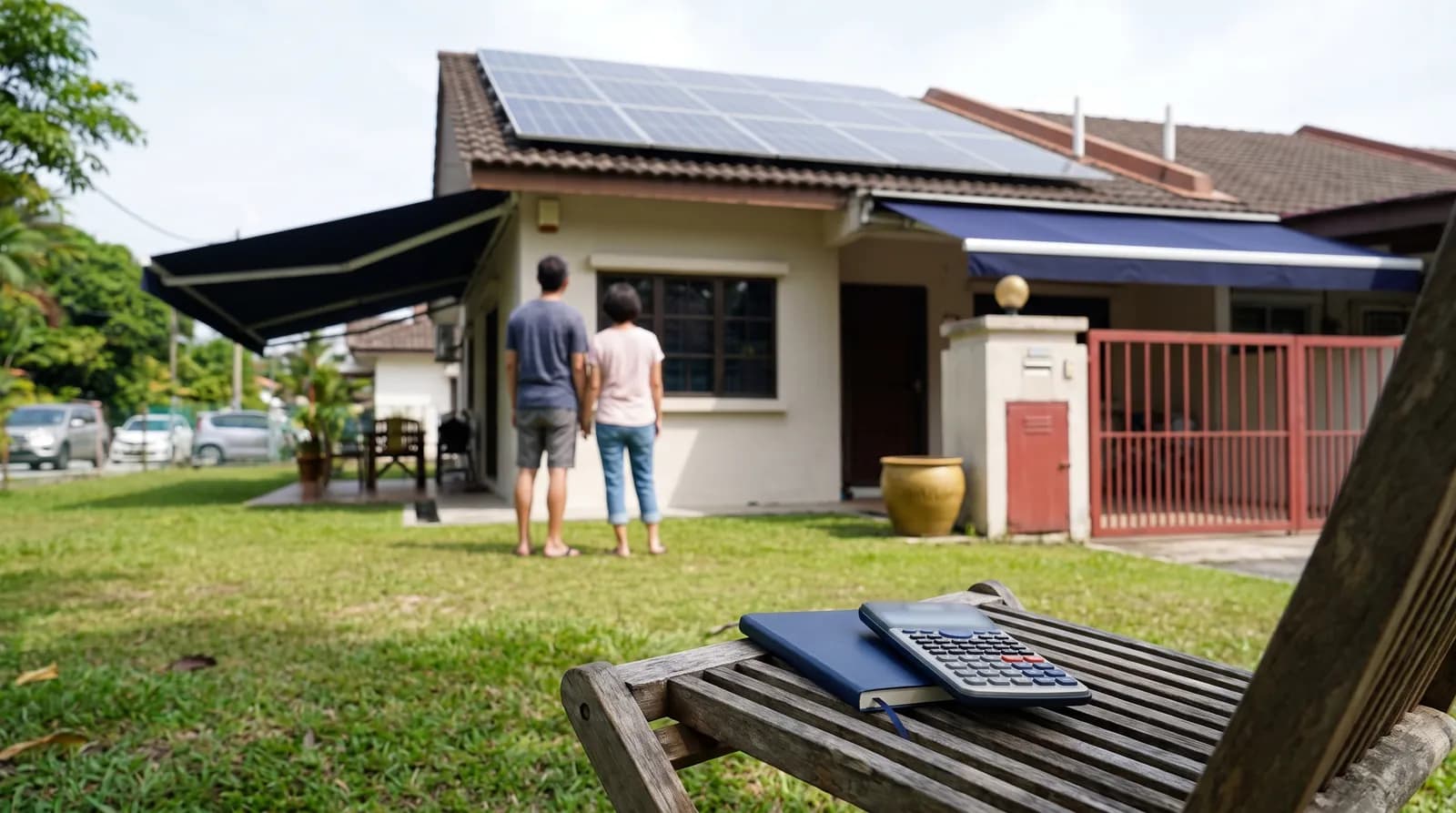
How Much Do Solar Panels Cost for a House in Malaysia? (2026 Guide)
Quick Answer
- - Terrace house: RM17,499 - RM17,999 (6.82–7.44kWp system, Solis inverter)
- - Semi-D house: RM21,499 - RM31,999 (8.06-12.40kWp system, Solis to Sungrow)
- - Bungalow: RM31,499 - RM40,499 (15.50-19.84kWp system)
- - Payback: about 3.4 to 7.2 years | 25-year savings: about RM44,760 - RM157,200 (examples below, RP4 tariff)
- - All prices are turnkey (panels + inverter + install + permits + meter)
“How much do solar panels cost?” is the single most common question we receive. The short answer: it depends on your house type, roof size, electricity consumption, and the component brands you choose. The detailed answer is in this guide — with three worked examples based on typical Malaysian houses.
This is not a sales page. Our pricing page has exact package prices. This guide is educational — designed to help you understand what drives the cost, what you should expect to pay, and whether solar is a good financial decision for your specific situation.
What Factors Affect the Cost of Solar Panels for a House?
1. System Size (kWp)
This is the biggest cost driver. System size is determined by your monthly electricity consumption. A house with a RM300/month TNB bill needs around 5.58 kWp. A house with a RM600/month bill needs about 8.68 kWp. The bigger the system, the higher the cost — but also the bigger the savings.
2. Roof Type & Condition
Different roof types require different mounting systems. Metal/zinc roofs are cheapest to install on (clamp mounts). Clay/concrete tile roofs need rail mounts with tile hooks — slightly more expensive. Flat roofs require tilt frame structures to angle the panels correctly, adding RM1,000-3,000 to the cost.
3. Inverter Brand
The inverter is the second most expensive component after the panels. Three main brands in Malaysia:
- Solis: Value option — reliable performance, lowest cost of the three
- Huawei SUN2000 (MAP0 series): Premium (+RM3,000) — FusionSolar monitoring app, AI-powered optimisation
- Sungrow: Premium (+RM5,000) — suited to future battery storage integration
4. Location & Accessibility
Houses in the Klang Valley typically have the most competitive pricing due to installer density. East Malaysia (Sabah, Sarawak) costs more (from RM29,499 for 5.58 kWp) because of freight, mobilisation and local-partner costs. Three-storey houses or difficult roof access may require scaffolding/crane (RM1,000-2,000 extra).
5. Electrical Infrastructure
If your house runs on single-phase power, Solar ATAP caps you at 5 kWac (up to 7.44 kWp with our systems); for a larger system you will need a 3-phase supply from TNB (ask TNB and your electrician for the cost). Older houses may also need electrical panel upgrades (RM300-800).
Scenario 1: Terrace House (RM15,999)
The Setup
Savings Projection
Solar ATAP allows you to export excess solar energy to TNB for bill credits, further reducing your effective payback period.
This is the most common scenario in Malaysia. A typical terrace house in Petaling Jaya, Shah Alam, or Subang Jaya has a south-facing rear roof of around 25-30 sqm — enough for 9-12 panels. The 5.58kWp system generates approximately 590 kWh/month, offsetting a good part of a typical terrace house's consumption.
Scenario 2: Semi-Detached House (RM21,999)
The Setup
Savings Projection
Solar ATAP bill credits for exported energy further reduce your effective payback period.
Semi-detached houses benefit significantly from solar because they have larger roof areas (40-60 sqm) and higher electricity consumption. The 8.68kWp system generates approximately 910 kWh/month. In our model, a RM600 bill drops to about RM254 a month while Solar ATAP export credits apply.
Scenario 3: Bungalow (RM25,999)
The Setup
Savings Projection
Solar ATAP bill credits for exported energy further reduce your effective payback period.
Bungalows often have the strongest solar ROI of any house type. Large roof areas (60-100+ sqm) leave room for bigger systems, and the high consumption means every kWh of solar you use at home avoids the RP4 domestic rate of RM0.5443/kWh (above 1,500 kWh a month). A 11.78kWp system generates approximately 1240 kWh/month.
Solar Cost vs TNB Bill Over Time
The real question is not “how much does solar cost?” — it is “how much does solar cost compared to not having solar?”
Cumulative Cost: Solar vs TNB (Semi-D Example, RM600/month bill)
| Timeframe | TNB Only (No Solar) | With Solar | Difference |
|---|---|---|---|
| Year 0 | RM0 | RM21,999 | -RM21,999 |
| Year 5 | RM36,000 | RM37,239 | -RM1,239 (breakeven in year 6) |
| Year 10 | RM72,000 | RM52,479 | +RM19,521 |
| Year 15 | RM108,000 | RM75,279 | +RM32,721 |
| Year 25 | RM180,000 | RM120,879 | +RM59,121 |
* RM600 bill with a 8.68 kWp Solis system (RM21,999): the bill falls to about RM254 a month while Solar ATAP export credit lasts (10 years), then to about RM380. No tariff increase and no inverter replacement are included. Estimate on the RP4 domestic tariff (from 1 Jul 2025), before AFA, the 1.6% RE Fund and service tax; 3.5 sun-hours a day; about 40% of solar used at home and the rest exported and credited at the 27.03 sen Energy Charge (capped at what you import) for 10 years under Solar ATAP; no tariff increases. Your bill and roof will change the figures.
The numbers are clear: over 25 years, the homeowner with solar saves about RM59,121 compared to the homeowner without solar, after paying the system cost. This assumes no tariff increase, so it is not a forecast of future TNB rates.
Financing Options — Spread the Cost
You do not need RM15,999-25,999 upfront. Here is what the monthly payments look like with financing:
| Financing Option | Interest Rate | Monthly Payment* | Monthly Savings | Net Cash Flow |
|---|---|---|---|---|
| Card 0% instalment (24m) | 0% | RM917 | RM346 | -RM571 |
| Maybank Solar PV Financing | Floating | Per bank quote | RM346 | Compare with quote |
| Pay in full | n/a | RM21,999 (lump sum) | RM346 | Payback 5.3 years |
* Based on the Scenario 2 semi-D system (8.68 kWp, RM21,999, RM600 bill). Card instalment = RM21,999 ÷ 24. Maybank Solar PV Financing: up to RM100,000, up to 10 years, floating rate; check the bank's current rate and terms on the Maybank Solar PV Financing page.
A 0% card instalment plan spreads the cost without interest (Affin, AmBank, HSBC, RHB, Standard Chartered: 3/6/12/24 months; Alliance, OCBC, UOB: 6/12/24 months), though a 24-month repayment is higher than the monthly saving. A longer green bank loan such as Maybank Solar PV Financing (up to 10 years, floating rate) gives a lower monthly repayment; check current terms with the bank. EPF (KWSP) Account 2 withdrawals are not available for solar. Read our detailed guide on green bank loans for solar.
Government Incentives That Reduce Your Cost
Solar ATAP Bill Credit Programme
Solar ATAP is a bill credit mechanism — not a cash subsidy. When your solar panels generate more electricity than you consume, the excess is exported to the TNB grid and credited to your TNB bill at the Energy Charge rate (RM0.2703/kWh for domestic, RM0.3703 above 1,500 kWh). Over a contract of up to 10 years, these credits can significantly offset your electricity costs; unused credit is forfeited at the end of each billing period. Solar ATAP does not pay cash for panels or reduce the upfront system price. Read the full details on our incentives guide.
Green Investment Tax Allowance (GITA)
Business owners can claim a 60% investment tax allowance on solar equipment under GITA, provided the system is commissioned and the MGTC application is submitted by 31 December 2026. This means 60% of the qualifying cost of your solar system can be set off against up to 70% of statutory income. For a company paying 24% corporate tax, a RM50,000 solar system effectively costs RM42,800 after the tax saving (RM50,000 × 60% × 24% = RM7,200). See our GITA tax guide for details.
What is Included in the Price?
When comparing quotes, make sure all of these items are included:
- Solar panels: Tier-1 Bloomberg panels (Jinko, LONGi, Trina) with written performance and product warranties (Trexon: Jinko, 30-year performance / 12-year product)
- Inverter: SEDA-approved inverter with minimum 10-year warranty
- Mounting structure: Anodised aluminium rails and stainless steel hooks
- Balance of System (BOS): DC/AC cables, MC4 connectors, combiner box, surge protector
- Installation labour: Installation crew, typically 1-2 days on site
- SEDA application: Solar ATAP application and RPVSP submission
- TNB meter upgrade: Bi-directional meter for export metering
- Commissioning & testing: System performance verification and handover
- Monitoring setup: App configuration for real-time generation tracking
If a quote does not include any of the above items — or does not specify the exact panel and inverter model — be cautious. Read our guide on how to avoid solar panel scams.
The Bottom Line
Solar panels for a house in Malaysia cost between RM15,999 and about RM40,500 depending on your house type and system size. The payback is about 3.4 to 7.2 years in our examples. After that, you keep the lower bill for the rest of the system's life.
The best way to get an accurate number for your specific house is to use our solar calculator. Enter your TNB bill amount and you will get an estimate showing the recommended system size, exact cost, monthly savings, and payback period.
Frequently Asked Questions
How much do solar panels cost for a terrace house in Malaysia?
A complete solar panel system for a typical 2-storey terrace house in Malaysia costs between RM17,499 and RM21,499 for a 6.82–8.06kWp system. This includes Tier-1 panels (Jinko 620W), inverter (Solis/Huawei/Sungrow), mounting structure, installation, SEDA application, and TNB meter upgrade. The exact price depends on inverter brand choice: Solis (cheapest), Huawei (+RM3,000), or Sungrow (+RM5,000).
How much do solar panels cost for a semi-D house in Malaysia?
A semi-detached house in Malaysia typically requires an 8-12kWp solar system, costing between RM21,499 and RM31,999 depending on inverter brand. Semi-Ds have larger roof areas and higher electricity consumption (RM400-700/month TNB bills), justifying a larger system. For example, on a RM600 bill our savings engine sizes a 8.68 kWp three-phase system (RM21,999 with a Solis inverter), which saves about RM346/month and pays back in about 5.3 years. Estimate on the RP4 domestic tariff (from 1 Jul 2025), before AFA, the 1.6% RE Fund and service tax; 3.5 sun-hours a day; about 40% of solar used at home and the rest exported and credited at the 27.03 sen Energy Charge (capped at what you import) for 10 years under Solar ATAP; no tariff increases. Your bill and roof will change the figures.
How much do solar panels cost for a bungalow in Malaysia?
Bungalows in Malaysia typically need 15-20kWp solar systems on the largest roofs, costing about RM31,499 to RM40,499 depending on inverter brand. Bungalows have the largest roof areas and highest consumption (RM800-2,000+/month). Despite the higher upfront cost, the payback is often the shortest because savings per month are highest: on a RM1,200 bill our savings engine sizes a 11.78 kWp three-phase system (RM25,999 with a Solis inverter) that saves about RM644/month and pays back in about 3.4 years. Estimate on the RP4 domestic tariff (from 1 Jul 2025), before AFA, the 1.6% RE Fund and service tax; 3.5 sun-hours a day; about 40% of solar used at home and the rest exported and credited at the 27.03 sen Energy Charge (capped at what you import) for 10 years under Solar ATAP; no tariff increases. Your bill and roof will change the figures.
Is it worth installing solar panels on a house in Malaysia?
Yes. In our worked examples the payback is about 3.4 to 7.2 years depending on your bill and system size, and 25-year savings range from about RM44,760 to RM157,200. After payback, the system keeps cutting your bill for the rest of its life. Solar ATAP bill credits let you export excess solar energy to TNB at the Energy Charge. Estimate on the RP4 domestic tariff (from 1 Jul 2025), before AFA, the 1.6% RE Fund and service tax; 3.5 sun-hours a day; about 40% of solar used at home and the rest exported and credited at the 27.03 sen Energy Charge (capped at what you import) for 10 years under Solar ATAP; no tariff increases. Your bill and roof will change the figures.
How much do I pay upfront to install solar panels in Malaysia?
Every Trexon route starts with a RM2,000 booking, credited in full to your system price. After that, several financing options let you spread the cost: pay by credit card at Trexon's checkout and choose a 0% instalment plan of up to 24 months (Affin, AmBank, HSBC, RHB and Standard Chartered: 3/6/12/24 months; Alliance, OCBC and UOB: 6/12/24 months). Bank loans are another option; check current terms with the bank.
How much does solar panel installation cost per kWp in Malaysia?
Trexon's 2026 Peninsular residential Solis catalogue is about RM1,790–RM2,870/kWp for systems from 5.58 kWp upwards; unit cost varies by system size. A Huawei inverter adds RM3,000 and Sungrow adds RM5,000 per system. These are all-inclusive turnkey prices covering panels, inverter, mounting, installation, permits, and meter upgrade.
Related Articles
Solar Panel Price Malaysia 2026
Complete cost breakdown by package size — from RM15,999.
Read moreSolar Panel ROI & Payback Period
Detailed ROI calculations for every system size.
Read moreSolar Financing Options
All financing options: 0% card instalments, green bank loans, OKAPI rent-to-own.
Read moreHow to Choose a Solar Company in Malaysia 2026
What to check before you choose a solar installer.
Read moreSolar Panel Cost by TNB Bill
Find the system size, price and estimated saving for your monthly TNB bill.
Read moreTrexon Solar Packages — Transparent Pricing
See all packages with exact component and price breakdown.
Read moreSee the Exact Cost for Your House
Enter your TNB bill amount and get a personalised proposal — system size, exact cost, savings projection, and payback period. No obligation.