Model your project savings and peak-demand reduction
Calculate ROIFor REITs, Property Trusts & Large-Scale Developers
Solar & EV for REIT and Property Portfolios
Portfolio-wide ownership or finance-lease structures, priced per project from your bills. GRESB-aligned, Scope 2-quantified, and structured around distributable income.
Per project
Priced from your bills
Per asset
IRR modelled from bills
GRESB + ISSB
Reporting Aligned
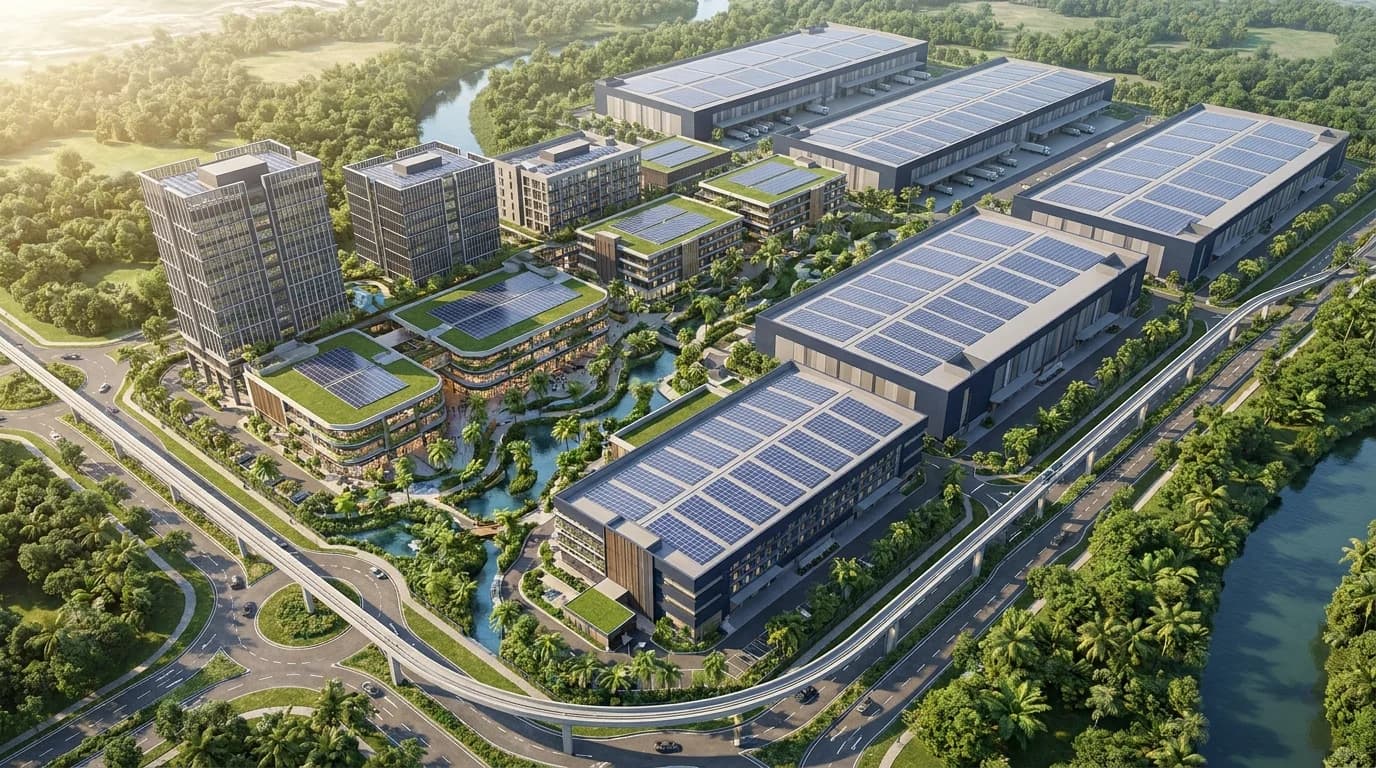
Illustrative solar concept. Site design follows engineering assessment.
The Four Pressures Every REIT CFO Faces
Malaysian REITs are caught between sustainability mandates, tenant expectations, and the need to preserve DPU. Solar can help with all four.
GRESB & Sustainability Ratings
REITs are scored annually on GRESB benchmarks. Lagging peers on renewable energy intensity erodes fund-manager appeal and raises cost of capital under ESG mandates.
Bursa Climate & ISSB Disclosures
Bursa's mandatory climate-related financial disclosures (aligned to ISSB/IFRS S2) require quantified Scope 2 reductions. On-site solar generation is a direct, auditable lever.
Green Lease Tenant Demand
Multinational tenants with their own CSRD and net-zero commitments increasingly mandate green lease clauses — or relocate. Solar-powered common areas are now a lease negotiation tool.
Capex Pressure on DPU
Every ringgit spent on energy is a ringgit not distributed. A finance lease through Mitsubishi HC Capital Malaysia spreads the cost into fixed monthly payments; accounting treatment is for your auditors to confirm.
Three Deal Structures. One Platform.
We match structure to your trust's balance sheet posture, tax position, and GRESB timeline.
01
Power Purchase Agreement (PPA) — explainer
Third-Party OwnedA PPA requires a third-party asset owner that finances and owns the system and sells the REIT its output at a contracted per-kWh rate. Trexon does not finance PPAs, and a REIT that does not own the system cannot claim GITA on it. Accounting treatment (e.g. MFRS 16) is for your auditors to confirm.
Trexon's own routes: outright ownership (GITA-eligible) or a finance lease
02
Equipment Lease (You Own It)
Bursa-Compliant · Asset OwnershipFixed monthly payments through Mitsubishi HC Capital Malaysia; rates and term are set by the lender. Because the trust owns the asset, the capital allowance and GITA stay with the trust (subject to MGTC verification and your auditors), and it can support GRESB scoring and Bursa climate disclosure as a quantified Scope 2 reduction.
Best for: trusts that want to own the asset while spreading payments
03
Capex Purchase (REIT-Owned)
Asset Ownership · GITA EligibleFull system purchase; IRR is modelled per project from your bills. The owner may claim the Green Investment Tax Allowance (GITA): 60% of qualifying capex set off against up to 70% of statutory income, provided the capex is incurred, the system commissioned and the MGTC application submitted by 31 December 2026. Under Solar ATAP, exports are credited at the monthly Average System Marginal Price (SMP), unused credit is forfeited monthly, and multi-tenant premises are not eligible.
Best for: developers and trusts with strong balance sheets and tax appetite
Every Asset Class in Your Portfolio
Shopping Malls
Roof + carpark canopy, EV bays; Solar ATAP caps non-domestic systems at 1,000 kWac per installation
Office Towers
Rooftop and carpark solar, green lease anchor
Hotels & Hospitality
Common-area and hot-water electrical load offset
Industrial & Logistics
Large flat roofs; payback modelled per site (Solar ATAP ceiling: 1,000 kWac per installation)
Retail Strips
Carpark canopy solar + EV charging revenue
Residential Strata
Common-area solar (JMB/MC); Solar ATAP eligibility confirmed with TNB per building
Built for REITs and property developers
From Audit to Rollout — Without Disrupting Tenants
1
Portfolio Energy Audit
We analyse 12 months of TNB bills across your asset portfolio, map roof areas via satellite, and model per-site yield using PVsyst.
2
Financial Modelling
Customised cashflow model per structure (Lease / Capex). Outputs: NPV, IRR, DPU impact, payback, GRESB score delta, Scope 2 tonne-CO₂ reduction.
3
Board Paper & Approvals
We draft the board paper — including GRESB rationale, ISSB disclosure language, and auditor-ready MFRS 16 notes — ready for your investment committee.
4
Phased Portfolio Rollout
Sites are phased to manage contractor capacity, TNB approval queues, and tenant disruption. Each site produces bankable production data for the next tranche.
Built for Malaysian Regulatory Reality
Solar ATAP: Exports are credited at the monthly Average SMP, unused credit is forfeited monthly, and multi-tenant premises are not eligible — so each meter point is assessed individually.
MD Reduction: Maximum Demand (MD) charges often exceed energy charges for large assets. BESS peak shaving can lower MD kW (solar alone does not); the reduction is modelled per asset.
GITA Tax Allowance: For the asset owner: 60% of qualifying capex set off against up to 70% of statutory income. Capex incurred, system commissioned and MGTC application submitted by 31 December 2026.
ISSB / IFRS S2 Ready: An M&V (Measurement & Verification) report aligned to ISSB S2 Scope 2 disclosure can be prepared, scoped per project, for Bursa Climate filings.
Planning a Portfolio-Wide Solar Programme
A portfolio programme usually starts with a screening of each asset: roof condition and ownership, tenancy and metering arrangements, tariff type and daytime load. Prepare the latest 12 months of TNB bills for each building, roof plans and single-line diagrams where available. Assets that pass screening can then be grouped into phases.
Explore how a power purchase agreement can place the system on the owner or a third-party balance sheet, compare financing options, and see how renewable energy certificates can support ESG reporting. For specific asset types, read about commercial solar, EV chargers and strata and JMB solar, and plan ongoing care with solar O&M services.
Commercial Solar
Get a Custom Solar Proposal for Your Portfolio
Tell us about your REIT or property portfolio and our commercial team will design a solar strategy that matches your DPU and ESG targets.
- Sizing from your 12 months of TNB bills and shift pattern
- Roof, switchboard and single-line diagram reviewed by our engineers
- Available incentives (GITA for solar, subject to MGTC verification) and Solar ATAP eligibility checked for your premises
- SEDA-registered PV Service Provider (RPVSP-2026/373) · SSM 201301044881 (1074704-D)
One portfolio briefing. Priced per asset from your bills.
We bring a full financial model — lease vs capex comparison, GRESB score projection, DPU impact analysis — for your investment committee.
Free quote
Board-paper-ready financial model
GRESB and ISSB disclosure support