Model your project savings and peak-demand reduction
Calculate ROISolar for Mosques
Reduce your masjid operating costs and redirect savings to community programs.
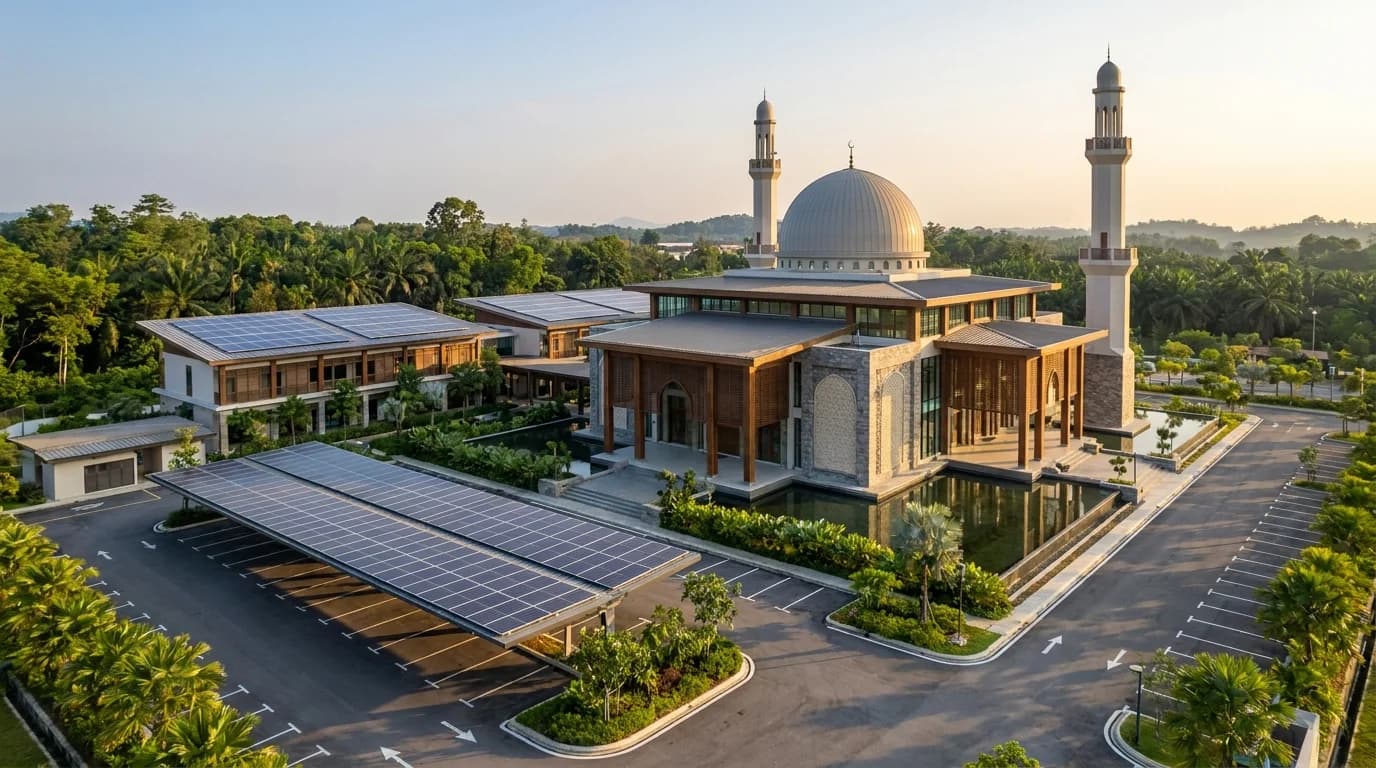
Why mosques and surau choose solar
Reduce Electricity Bills
Reduce monthly utility costs
Community Crowdfunding
Allow jamaah to contribute (Sadaqah Jariah)
Tax Relief Check
Deductible only for s44(6)-approved institutions
Typical Mosque Installation
Small Surau (10.54 kWp catalogue system)
- - 10.54 kWp system
- - Price: RM 24,499 (catalogue)
- - Monthly savings: about RM 400 on our headline model
- - Payback: about 5.1 years on that model; your quote is modelled from your own bill
Large Masjid (above 19.84 kWp)
- - System sized from the roof and the bill
- - Investment: priced per project
- - Monthly savings: modelled from your TNB bill
- - Payback: shown in your proposal
How a mosque solar project works
Most mosques and surau use the most electricity during the day: air-conditioning and fans before and during prayers, lighting, sound systems, water pumps and classrooms for religious classes. Because rooftop solar generates in daylight, a well-sized system can offset a meaningful share of that daytime consumption. The actual result depends on your tariff, roof and usage pattern, so every system is sized from your own bills rather than a rule of thumb.
Sizing also takes into account when the building is busiest. Friday prayers, Ramadan and community events can lift demand well above a normal weekday, while a quiet surau may use very little outside prayer times. Understanding that rhythm helps us avoid an oversized system and keeps the proposal honest about what solar can and cannot offset.
What we ask for
- - Your latest 12 months of TNB bills (at least 6 months if the account is new).
- - A roof plan or clear photos of the roof, the distribution board and the TNB meter.
- - A single-line diagram of the electrical installation, if the mosque has one.
Roof, structure and approvals
A site assessment checks the roof material and condition, orientation, shading from domes and minarets, structural capacity and cable routes to the main switchboard. The mosque committee (AJK) makes the decision, and where the building falls under a state religious authority or sits on waqf land, written approval from that body may also be required before installation. Ask us for a clear scope document you can table at your committee meeting.
Funding and keeping the system running
Many mosques fund solar through a mix of the mosque account, community contributions and financing. Jamaah can take part through a crowdfunding campaign as sadaqah jariah, and you can compare solar financing options or estimate your savings with the commercial solar ROI calculator. After installation, regular panel cleaning and inspection keep output steady; see our solar O&M services. Schools and madrasah attached to your mosque may also benefit from our school and campus solar guidance.
Get Quote
Reduce your masjid operating costs and redirect savings to community programs.
- Sizing from your 12 months of TNB bills and shift pattern
- Roof, switchboard and single-line diagram reviewed by our engineers
- Available incentives (GITA for solar, subject to MGTC verification) and Solar ATAP eligibility checked for your premises
- SEDA-registered PV Service Provider (RPVSP-2026/373) · SSM 201301044881 (1074704-D)
Prefer to talk first? Message our commercial team on WhatsApp.
WhatsApp UsFrequently Asked Questions
Is solar installation permissible (halal) for mosques?
Yes. Solar energy aligns with Islamic principles of environmental stewardship (khalifah). Confirm with your mosque committee or state religious authority how a solar waqf or contribution should be structured.
How does the crowdfunding process work?
We can help you plan a contribution campaign and share campaign materials and guidance. Trexon's own crowdfund pages only register interest and do not take payments.
Can solar bring our electricity bill to zero?
Not guaranteed. Systems are sized to your mosque's consumption and Solar ATAP credits excess solar energy against your bill, but unused export credit is forfeited at the end of each billing period and fixed charges still apply.
What happens during cloudy days or at night?
Your mosque remains connected to TNB grid. During cloudy periods or at night, you draw from the grid. Excess energy generated during sunny days earns export credits that are applied against that billing period's bill; unused credit is forfeited at the end of each billing period.
Who maintains the system after installation?
Solar systems require minimal maintenance - just occasional cleaning. The system carries a 30-year panel performance warranty, 12-year panel product warranty, 10-year inverter warranty and 5-year workmanship warranty, and maintenance packages are available.
Can corporate sponsors get tax benefits?
Possibly. A contribution is tax deductible only if it is made to an institution approved under section 44(6) of the Income Tax Act, or otherwise qualifies under LHDN rules — sponsors should confirm with their tax adviser. We provide all necessary documentation for their ESG reporting and tax filing requirements.