Build your solar plan — no payment until you approve
Configure solarString Inverter
vs Micro Inverter
The complete Malaysia 2026 buyer’s guide. Indicative pricing from local distributors, performance data for tropical conditions, and honest recommendations.
What Is a Solar Inverter?
Your solar panels produce DC (Direct Current) electricity. Your home runs on AC (Alternating Current). The inverter is the bridge — it converts DC to AC so your appliances can use the solar energy. Without it, your panels are useless.
But not all inverters work the same way. The two main architectures — string inverters and micro inverters — have fundamentally different approaches to this conversion. Each has real advantages depending on your roof, budget, and goals.
Why This Decision Matters
The inverter is the most failure-prone component in a solar system and accounts for roughly 15-20% of your total cost. Panels last 25-30 years with minimal degradation. Your inverter choice determines your system’s real-world performance, maintenance burden, and total cost of ownership for the next decade.
How Each Type Works
Two fundamentally different architectures. Tap each diagram to understand the flow.
String Inverter System
All panels wired in series to one inverter
Micro Inverter System
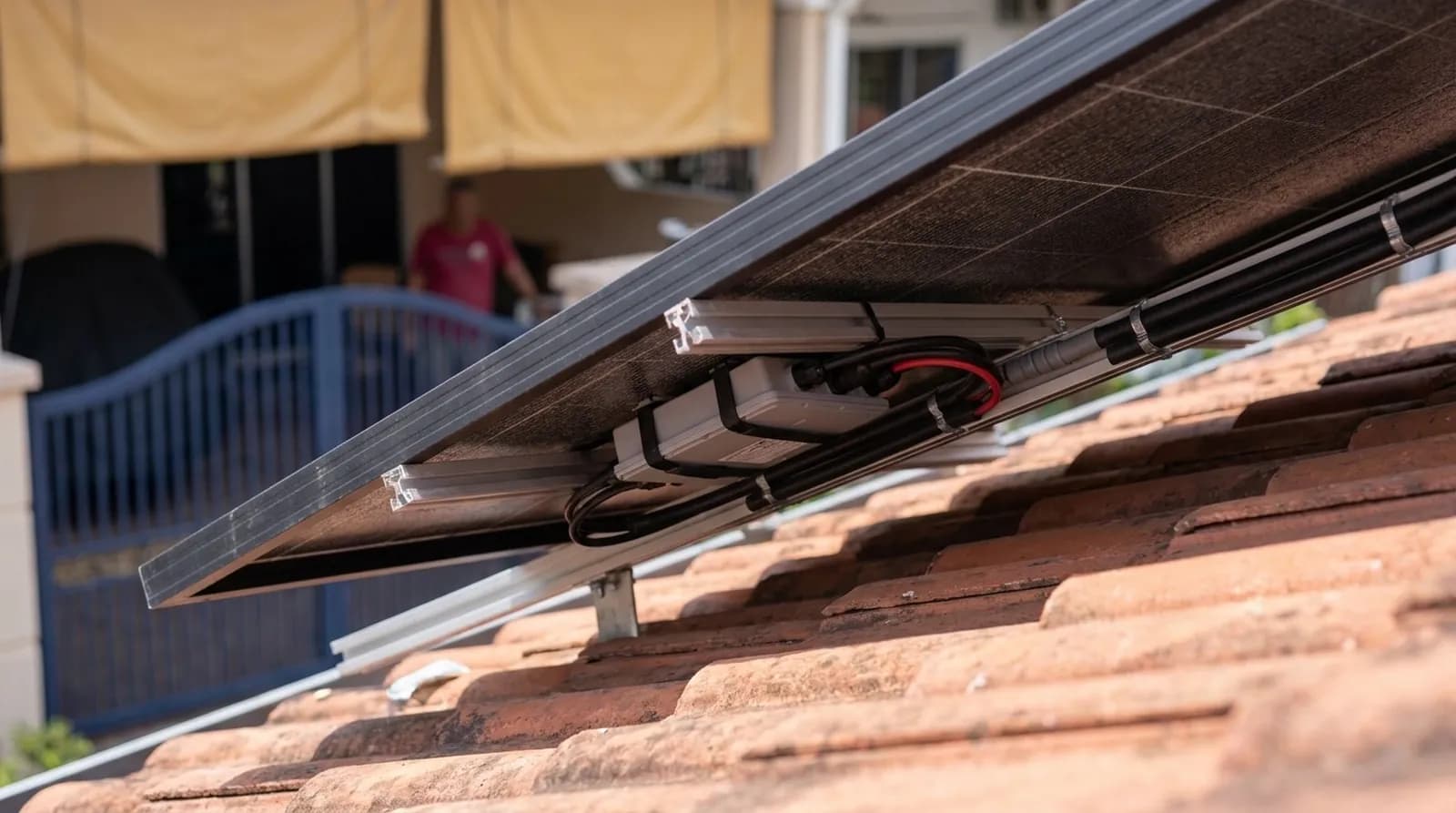
Each panel has its own inverter
💡 The “Christmas Light Effect”
In a string inverter system, panels are wired in series — like old Christmas lights. If one panel is shaded, dirty, or damaged, it becomes a bottleneck for the entire string. A single panel producing 30% less can drag your entire system down by 15-20%.
The fix: Modern string inverters (Huawei, SolarEdge) offer DC power optimizers — small devices on each panel that mitigate this effect. They cost RM 100-200 per panel extra but give you 80% of the micro inverter benefit at 50% of the cost.
Head-to-Head Comparison
12 critical factors compared. Click any row for more detail. Filter by winner to see strengths at a glance.
Malaysia 2026 Pricing
Market estimates from Malaysian distributors. These are inverter-only costs — full system pricing includes panels, mounting, wiring, and installation.
Sungrow
SG5K-D / SG8K-D / SG10KTL-M
China
10 years
Good value and a proven track record. Monitoring through the iSolarCloud app.
Huawei
SUN2000-5KTL / 8KTL / 10KTL
China
10 years
Smart PV with AI optimization. Optional DC optimizers for shading. FusionSolar app. Strong after-sales in Malaysia.
GoodWe
GW5000-MS / GW8K-DT
China
10 years
Budget-friendly Tier 1 option. Popular with installers for residential systems. SEMS monitoring portal.
SMA
Sunny Boy 5.0 / 6.0
Germany
5 years (ext. to 20)
German engineering, premium build. Less common in Malaysia due to higher price. Best for those wanting European quality.
Total System Cost Example (8kW)
* BOS = Balance of System (mounting, wiring, meter, permits). Prices are indicative — request a custom quote for exact pricing.
Shading & Performance in Malaysia
Malaysia’s tropical environment presents unique challenges: tall palm trees, rain trees, neighboring buildings, and afternoon thunderstorm clouds. Shading is the #1 performance killer for solar systems.
No Shading
Clear, unobstructed roof with good orientation. String inverter is the clear winner — an estimated 20-30% cheaper with marginally better efficiency (96-98.5% vs 95-97%).
Partial Shading
1-3 panels affected for part of the day (trees, chimney, water tank). String + DC optimizers is the cost-effective play. Full micro if budget allows.
Heavy Shading
Multiple panels shaded for hours — tall trees, adjacent building, complex multi-roof layout. Micro inverters are essential. An estimated 10-25% more yield vs string in heavy shade.
Estimate for Malaysia: On partially shaded roofs, string inverter systems typically produce 8-15% less annual kWh than equivalent micro inverter systems. On fully unshaded roofs, string inverters produce 1-2% more due to higher conversion efficiency.
Top Brands Available in Malaysia
Not all brands are readily available here. We compare inverters with local warranty support and proven track records in Southeast Asian climates. Trexon installs Solis, Huawei, Sungrow and GoodWe; the other brands are market estimates for comparison, not stocked by Trexon.
String Inverter Brands
Sungrow
SG5K-D / SG8K-D / SG10KTL-M
China
10 years
Good value and a proven track record. Monitoring through the iSolarCloud app.
Huawei
SUN2000-5KTL / 8KTL / 10KTL
China
10 years
Smart PV with AI optimization. Optional DC optimizers for shading. FusionSolar app. Strong after-sales in Malaysia.
GoodWe
GW5000-MS / GW8K-DT
China
10 years
Budget-friendly Tier 1 option. Popular with installers for residential systems. SEMS monitoring portal.
SMA
Sunny Boy 5.0 / 6.0
Germany
5 years (ext. to 20)
German engineering, premium build. Less common in Malaysia due to higher price. Best for those wanting European quality.
Micro Inverter Brands
Enphase
IQ8+ / IQ8M / IQ8A
USA
25 years
Industry benchmark among micro inverters globally. Enphase Envoy gateway + Enlighten app. Not widely stocked in Malaysia — may need import.
Hoymiles
HMS-1600-4T / HMS-2000-4T
China
12 years (ext. to 25)
Micro inverter option. Growing in Southeast Asia. S-Miles Cloud monitoring. Multi-panel units (2-in-1, 4-in-1) reduce cost.
APsystems
DS3 / QS1
China/France
12 years (ext. to 25)
Dual/quad micro inverter innovator. EMA app for monitoring. Good middle-ground between Enphase and Hoymiles.
Common options for 2026
Widely used in Malaysia, with a 10-year warranty and the iSolarCloud monitoring app. Compare against your own quote.
4-in-1 design lowers per-panel cost. 12-year warranty (extendable to 25). S-Miles Cloud monitoring. Informational only: not stocked by Trexon.
Which Should You Choose?
Your situation determines the right answer. Find your scenario below.
Simple Roof, Tight Budget
Unshaded single-orientation roof with a budget of around RM 21.5–26.5K for an 8kW-class system. Sungrow or Huawei string inverter saves you about RM 2,500-3,500 vs micro. ROI payback about 6.4-7.3 years (8.06 kWp, Solis to Huawei price).
Shaded Roof / Multiple Orientations
Trees, neighboring buildings, or panels facing different directions. Micro inverters recover an estimated 10-25% more energy in shade, justifying the premium over 25 years.
Future Expansion Plans
Starting with 4kW now and adding more later? Micro inverters let you add one panel at a time. String inverters lock you into the inverter's max capacity.
Commercial / Industrial
Large flat roofs with minimal shading. Commercial systems (30-100kW+) are almost always string — the cost savings at scale are massive and maintenance is centralized.
Maximum Safety Priority
No high-voltage DC on your roof. Each panel outputs safe low-voltage AC. Critical for homes with thatched elements, close tree canopy, or fire safety concerns.
Best ROI / Payback Period
On unshaded roofs, string inverters have an estimated 15-25% better ROI due to lower cost. On shaded roofs, micro inverters produce enough extra energy to match or beat string ROI.
The Bottom Line
All of Trexon's residential catalogue packages use string inverters (Solis, Huawei, Sungrow or GoodWe). For most homes with a simple, unshaded roof and a focus on value, a quality string inverter (Sungrow, Huawei) is the smartest choice.
If your roof has shading or complex geometry, or you want panel-level monitoring, micro inverters (Hoymiles, Enphase) may be worth the premium.
Frequently Asked Questions
Not Sure Which Inverter Is Right for Your Roof?
Our solar engineers will assess your roof, shading conditions, and budget to recommend the optimal inverter type. Free quote, no obligation.
SEDA-registered installer • Serving Klang Valley, Selangor, KL, Penang & Johor
Related Guides