Model your project savings and peak-demand reduction
Calculate ROI Energy Storage Solutions
Industrial Battery Storage
BESS Malaysia 2026
Reduce TNB Maximum Demand (MD) charges based on your load profile (modelled from your interval data), protect critical loads with battery backup, and check GITA (MGTC) eligibility with high-performance lithium LFP storage.
Modelled
MD Charge Reduction
GITA
Eligibility Review
Per design
Backup Switchover
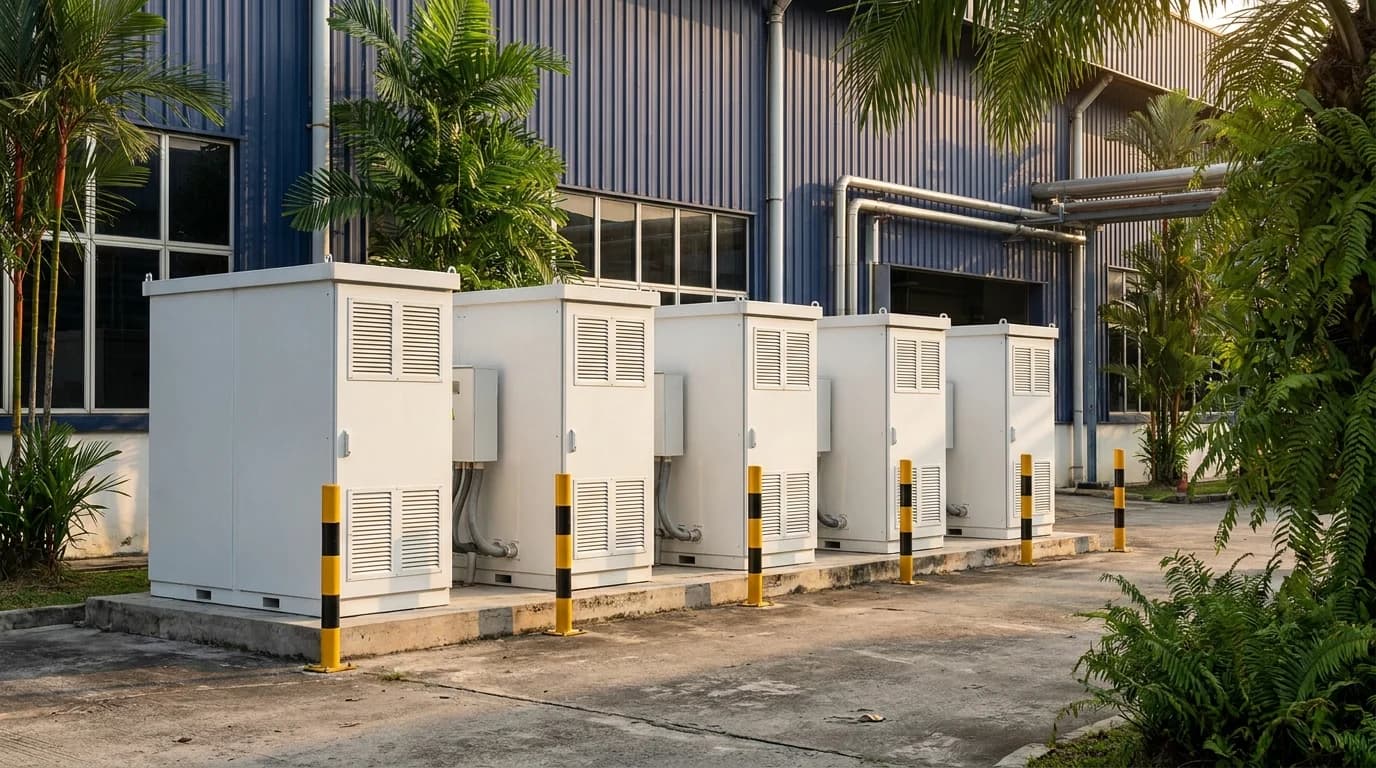
Featured System
Commercial Lithium LFP BESS cabinet (250kW / 500kWh, illustrative; manufacturer chosen per project, not stocked)
BESS Savings & Payback Estimator
Input your facility details to estimate system sizing, maximum demand savings, tax benefits, and ROI.
System Settings
RM 45,000
RM 15kRM 150kRM 300k+
Indicative BESS size
68 kW / 136 kWh
Sized to shave the peak you target (30% is an illustrative assumption). Modular expansion configuration, specified per project.
Est. Annual Savings
RM 80,529
MD Shaving:RM 79,201/yr
Arbitrage:RM 1,328/yr
Financial Return & Incentive Scenario
Indicative CapEx (RM1,300–2,100/kWh, quoted per site)RM 176,800–285,600
Indicative Tax Offset verify- RM 42,432–68,544
Net System CostRM 134,368–217,056
PaybackModelled per site
*BESS is quoted per site; the range uses RM1,300–2,100/kWh. Estimates assume typical factory load factors and optimal daily cycling. Incentive assumptions are verified during proposal review. Actual pricing depends on site electrical configurations.
Why Install Industrial Batteries?
Improve your facility's energy efficiency, protect uptime, and get more value from your solar.
Crush Maximum Demand
TNB charges RM31.21 to RM97.06 per kW of Maximum Demand monthly, depending on tariff. BESS automatically discharges to shave load peaks; the reduction in demand charges is modelled from your interval data.
Blackout Shield Backup
Grid drops can stop production lines. A grid-forming BESS can switch critical loads over automatically; the switchover time depends on the equipment selected and is confirmed in the design.
Accelerated solar ROI
Store excess midday solar generation that would otherwise go unrewarded under zero-export requirements. Shift self-consumption into evening and night operations.
Scheduled Discharge Control
Discharge is scheduled around your maximum-demand periods and tariff windows, configured per project from your load profile.
Premium LFP Battery Architecture
Trexon specifies industrial-grade Lithium Iron Phosphate (LiFePO4) chemistry for all C&I projects. LFP is the global standard for heavy energy storage due to its strong thermal stability.
6,000+ Cycle Lifespan
Provides roughly 15 to 20 years of daily deep-cycle service with minimum capacity degradation.
Manufacturer Warranty
Backed by the hardware manufacturer's warranty and an O&M package set out in your proposal.
Liquid Cooling System
Internal liquid cooling loops maintain exact, stable temperature parameters, prolonging LFP cell life.
Seamless Generator Integration
Dual inverters interface directly with backup diesel generators to construct robust off-grid microgrids.
Sizing Configurations
Remote Telco Site50 kWh / 25 kW BESS
Supports continuous power for remote communications towers.
Plantation / Estate60 kWh / 30 kW BESS
Off-grid processing power and labor housing lighting.
Community Microgrid100 kWh / 50 kW BESS
Powers isolated longhouses and off-grid villages.
Off-Grid Island Resort250 kWh / 125 kW BESS
Reduces diesel generator running hours and their maintenance.
Heavy Manufacturing Facility500 kWh - 2 MWh+ Custom
Shaves heavy grid peaks and covers automated production lines.
Engineered for Malaysia's Core Verticals
Tailored storage discharge profiles aligned to specific industrial operations.
Electronics & Semiconductors
Operation challenge: Voltage sags and flickers drop expensive silicon wafers.
Trexon storage solution: Backup mode takes over critical cleanroom loads, with the switchover time set by the equipment selected and confirmed in the design.
Cold Storage & Logistics
Operation challenge: Conveyors and compressors create massive peak spikes.
Trexon storage solution: Active peak-shaving discharges BESS exactly during heavy compressor start sequences to keep MD charges flat.
Food & Beverage Processing
Operation challenge: Continuous baseloads and high thermal requirements.
Trexon storage solution: Charges storage on cheap off-peak rates overnight and discharges during daytime heat cycles to reduce blended tariffs.
Rubber & Glove Factories
Operation challenge: MNC supply chains increasingly ask for verified carbon data.
Trexon storage solution: Pairing battery storage with solar PV offsets grid electricity and provides metered data to support carbon reporting.
Metal Fabrication & Machining
Operation challenge: Heavy CNC arc machines cause high maximum demand spikes.
Trexon storage solution: BESS acts as a buffer to absorb rapid kVA demand surges, insulating the factory from TNB rate penalties.
Palm Oil Estates & Agri
Operation challenge: Off-grid locations face high diesel fuel costs.
Trexon storage solution: Off-grid solar + battery microgrid replaces diesel generation; cost per kWh and payback are modelled per site.
FAQ: BESS for Malaysian Industry
What is Maximum Demand (MD) and how does BESS solve it?
TNB bills medium and high-voltage industrial consumers a Maximum Demand charge (RM31.21 to RM97.06 per kW depending on tariff: HV General RM31.21, HV ToU RM44.82, MV General RM89.27, MV ToU RM97.06). This charge is calculated based on your single highest 30-minute average power draw of the month. A BESS system monitors this draw in real-time. When it detects a spike approaching your limit, it immediately discharges battery power to cap the peak draw from the TNB grid. This reduces your recorded MD for the month, dropping your bill.
How does the Green Investment Tax Allowance (GITA) apply to BESS?
GITA eligibility for BESS depends on the project structure, equipment certification, renewable-energy linkage and MGTC verification. BESS is GITA Asset Tier 1 (100% of qualifying capex), set off against up to 70% of statutory income; the system must be commissioned and the application submitted to MGTC by 31 December 2026. Trexon treats the tax incentive as a verification item in the proposal rather than assuming every battery project qualifies automatically.
Can BESS completely replace diesel generators for factory backup?
Yes, for short-to-medium-duration blackouts. Modern BESS systems can be set to backup mode with a grid-forming inverter, with an automatic transfer switch; switchover time depends on the equipment chosen and is confirmed in the design. Backup duration depends on battery kWh and load, without the fuel cost, noise or high maintenance of diesel generators. For remote plantations or off-grid sites, a hybrid solar + battery + generator configuration is recommended for multi-day resilience.
What is the typical lifespan and cycle rating of the BESS Trexon installs?
The BESS manufacturer selected for your project typically uses Lithium Iron Phosphate (LiFePO4) cells rated for 6,000+ complete charging cycles at 80% Depth of Discharge (DoD). This translates to 15 to 20 years of daily operation. The systems are managed by smart Battery Management Systems (BMS) with active liquid thermal regulation and carry the hardware manufacturer's warranty set out in your proposal.
Does BESS require extensive electrical room remodeling?
No. BESS enclosures are typically weather-resistant, IP55/IP65 modular outdoor cabinets (the manufacturer is selected per project; BESS is not stocked by Trexon and specifications follow the manufacturer). They are designed to be placed outside your primary electrical room—typically on a concrete pad adjacent to your main distribution board (MDB) or substation—minimizing workspace disruption during installation.
Commercial Solar
Get a Factory BESS Peak Shaving Model
Share your MD profile, tariff category and backup requirement. Trexon will size the battery, model dispatch and route the inquiry to the Trexon commercial team.
- Sizing from your 12 months of TNB bills and shift pattern
- Roof, switchboard and single-line diagram reviewed by our engineers
- Available incentives (GITA for solar, subject to MGTC verification) and Solar ATAP eligibility checked for your premises
- SEDA-registered PV Service Provider (RPVSP-2026/373) · SSM 201301044881 (1074704-D)