Model your project savings and peak-demand reduction
Calculate ROIPasir Gudang
Industrial Area
Heavy Industry, Petrochemicals & Palm Oil
An integrated heavy manufacturing corridor in Johor. Systems of 500 kWp+.
Planning industrial solar or factory solar for a plant here? Start with the park-specific numbers below.
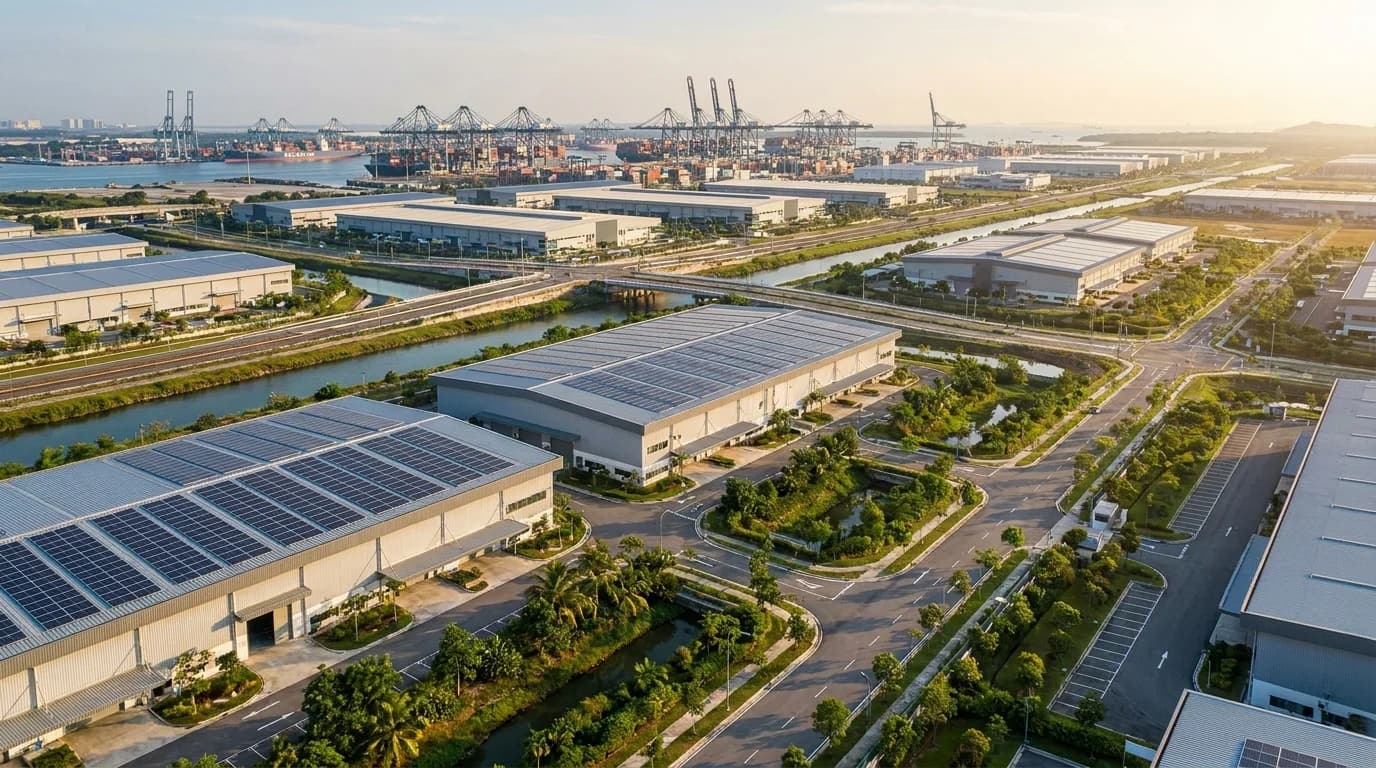
PGIA Park Snapshot
Illustrative, quoted per site. Payback ~6.4 years (MV General, on-site use only) | Post-GITA ~5.5 years
Industry Breakdown at Pasir Gudang
Pasir Gudang is a large heavy industry cluster — petrochemicals, oleochemicals, and large-scale manufacturing operations running continuously at high maximum demand (MD). Solar cuts daytime energy charges; MD reduction needs a BESS.
Petrochemical Processing
24/7 continuous operations. Very high MD. Solar on warehouses and utility buildings is self-consumed under Solar ATAP to offset MV tariff energy charges.
Oleochemical & Palm Processing
Large single-storey processing halls. Carports and utility buildings add generation capacity.
Polymer & Plastics
High-energy injection moulding and extrusion. Predictable daytime shift loads match solar generation windows.
Heavy Engineering
Fabrication yards with large covered workshops. Carport solar arrays on vehicle and equipment parks deliver significant yield.
Port-Support & Logistics
Tank farms and transshipment facilities. Solar on admin buildings and warehouses delivers pure cost reduction with no process risk.
Solar Potential Analysis — Pasir Gudang
High energy consumption across Pasir Gudang's heavy industry creates a large absolute savings opportunity.
System Sizing by Installation Type
Illustrative savings: Modelled from your bills
Illustrative savings: Modelled from your bills
Financial Parameters
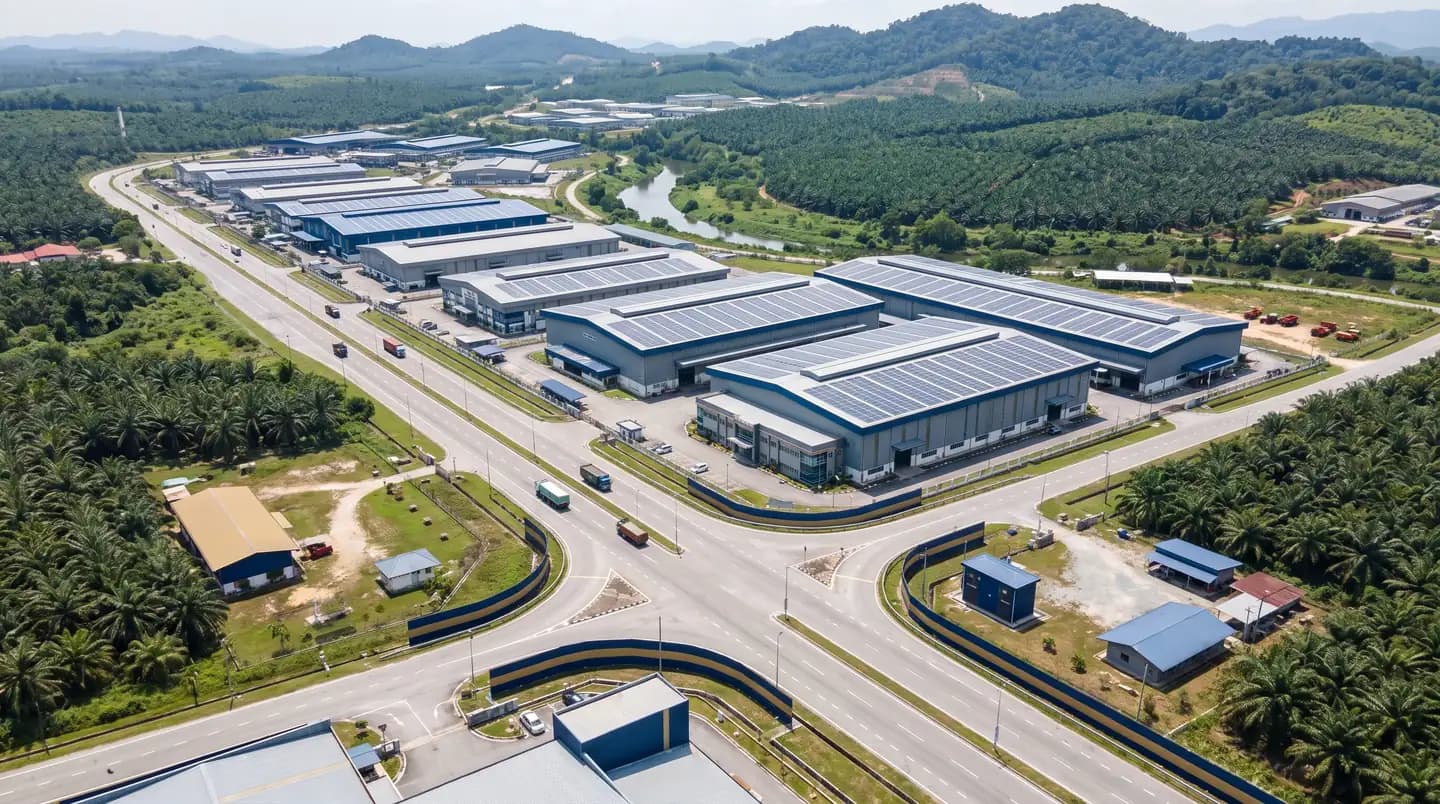
Johor's Integrated Petrochemical & Port Corridor
Pasir Gudang Industrial Area is strategically anchored by Pasir Gudang Port — Johor's primary bulk cargo and chemical handling terminal — positioned 35 km east of Johor Bahru along the Straits of Johor. The zone is a large continuous industrial footprint.
The combination of port access, flat industrial land, and a concentration of continuous heavy manufacturing creates a unique solar opportunity: extremely high baseload consumption means near-zero export waste, maximizing the financial value of every kWp installed.
Modelled solar yield: about 3.5 kWh per kWp per day. Grid: TNB Pasir Gudang supply — voltage confirmed per site.
Location Reference
Pasir Gudang Industrial Area
Johor Bahru, Johor
Frequently Asked Questions
Specific to Pasir Gudang heavy industry and petrochemical operations
Is solar viable on petrochemical and oleochemical plant rooftops at Pasir Gudang?
Can solar offset very high monthly consumption at PGIA?
What is a realistic system size for a Pasir Gudang petrochemical site?
Are Pasir Gudang plants eligible for GITA if they are partially government-linked?
How does Pasir Gudang Port proximity affect logistics for solar installation?
Get Your Pasir Gudang Solar Feasibility Report
Heavy industrial solar engineering, Solar ATAP modelling for high-voltage consumers, and GITA documentation. Request a free quote for your PGIA facility.
Pasir Gudang: Johor's Heavy Industrial Zone and the Case for 500 kWp+ Solar
Pasir Gudang Industrial Area (PGIA) is a continuous heavy industrial corridor along the eastern Johor coastline. Established in the 1970s as a petrochemical and oleochemical hub anchored by Pasir Gudang Port, the zone today hosts major facilities spanning petrochemicals, oleochemicals, polymer processing, heavy engineering fabrication, and port-support logistics. The port provides direct sea access for raw material imports and finished goods exports.
Industrial tenants at PGIA are large energy consumers, running continuous petrochemical and oleochemical operations. This creates a fundamentally different solar economics case compared to lighter industrial parks: even a large 500 kWp or 1 MWp rooftop system covers only a small fraction of total site consumption — meaning every kWh generated is self-consumed at full tariff value with near-zero export waste.
Maximum Demand Management at PGIA
Under TNB's Medium Voltage General tariff, the maximum demand (MD) charge is RM 89.27 per kW per month (RP4, post-July 2025; RM 97.06 on MV ToU, RM 31.21–44.82 at high voltage). A heavy manufacturing facility on MV General with a 2,000 kW MD reading pays RM 178,540 per month in MD charges alone — before a single kWh of energy consumption is billed. Solar alone does not reliably cut MD, so peak-demand management (including BESS) is assessed separately from your own bills. An illustrative 1 MWp rooftop system generating about 1.26 million kWh annually saves approximately RM 376,000 a year in energy chargesat the MV General energy rate (RM0.2983/kWh), if all output is used on site. Payback is about 6.4 years at RM2,400/kWp before SST, or about 5.5 years after GITA (up to RM 345,600 of tax value at a 24% tax rate).
CBAM Compliance: Solar as an Export Competitiveness Tool
The EU Carbon Border Adjustment Mechanism (CBAM) — fully enforced from January 2026 — imposes carbon levies on exports of steel, aluminium, cement, fertilisers, electricity, and hydrogen into the EU market. PGIA manufacturers of these goods that export to the EU may be exposed. On-site renewable generation via solar PV reduces your Scope 2 emissions and ESG footprint. For CBAM, indirect (electricity) emissions count only for cement and fertilisers in the transition phase, so for steel and aluminium it does not change the CBAM figure. Whether CBAM applies depends on what your site produces.
Getting Started: PGIA Solar Feasibility
Trexon Energy scopes rooftop systems on warehouses and utility buildings, carport structures for fabrication yard vehicle parks. Our factory solar solutions and industrial solar solutions pages cover system design approaches for heavy industry. For an immediate savings estimate based on your monthly TNB bill, use our calculator.
Get a Solar Proposal for Pasir Gudang
Tell us about your facility in Pasir Gudang and we'll design a tailored solar system.
- Sizing from your 12 months of TNB bills and shift pattern
- Roof, switchboard and single-line diagram reviewed by our engineers
- Available incentives (GITA for solar, subject to MGTC verification) and Solar ATAP eligibility checked for your premises
- SEDA-registered PV Service Provider (RPVSP-2026/373) · SSM 201301044881 (1074704-D)
Prefer to talk first? Message our commercial team on WhatsApp.
WhatsApp Us