What is Solar ATAP?
Malaysia's new solar export credit programme, replacing NEM 3.0 from 1 January 2026.
Solar ATAP — the Solar Accelerated Transition Action Programme — is Malaysia's replacement for the Net Energy Metering (NEM) 3.0 programme. It took effect on 1 January 2026 and is governed by gazette GP/ST/No. 60/2025, issued by the Energy Commission (Suruhanjaya Tenaga) and signed by CEO Siti Safinah Binti Salleh on 30 December 2025. Administration is handled by SEDA Malaysia (Sustainable Energy Development Authority).
Unlike NEM 3.0, which had a fixed national quota (450 MW) that caused long waiting lists, Solar ATAP operates with no national capacity ceiling. Any eligible property can apply at any time — first come, first served, and the queue never closes.
Official Sources
How it works in plain language
You install solar panels. During the day, your panels generate electricity. Whatever you do not use goes back to the TNB grid and earns a bill credit at the ATAP export rate. That credit offsets what you draw from the grid at night or on cloudy days. At the end of each month, any unused credit is reset to zero — it does not carry forward and cannot be cashed out.
The programme covers Peninsular Malaysia and Labuan under TNB jurisdiction. Sabah (SESB) and Sarawak (SEB) have their own separate programmes — see our NEM Sarawak guide for details.
A key structural difference from NEM 3.0: the export rate you receive is now tiered based on your electricity consumption, not fixed for everyone. This rewards higher-consuming households — the ones who stand to benefit most from a larger solar system — with a better export rate.
Solar ATAP also expands scope beyond rooftop installations. Solar carparks and covered walkways fitted with solar panels are explicitly eligible, opening the door for commercial and industrial properties that lack sufficient rooftop area.
For a full programme overview and to check your eligibility, visit our dedicated Solar ATAP programme page.
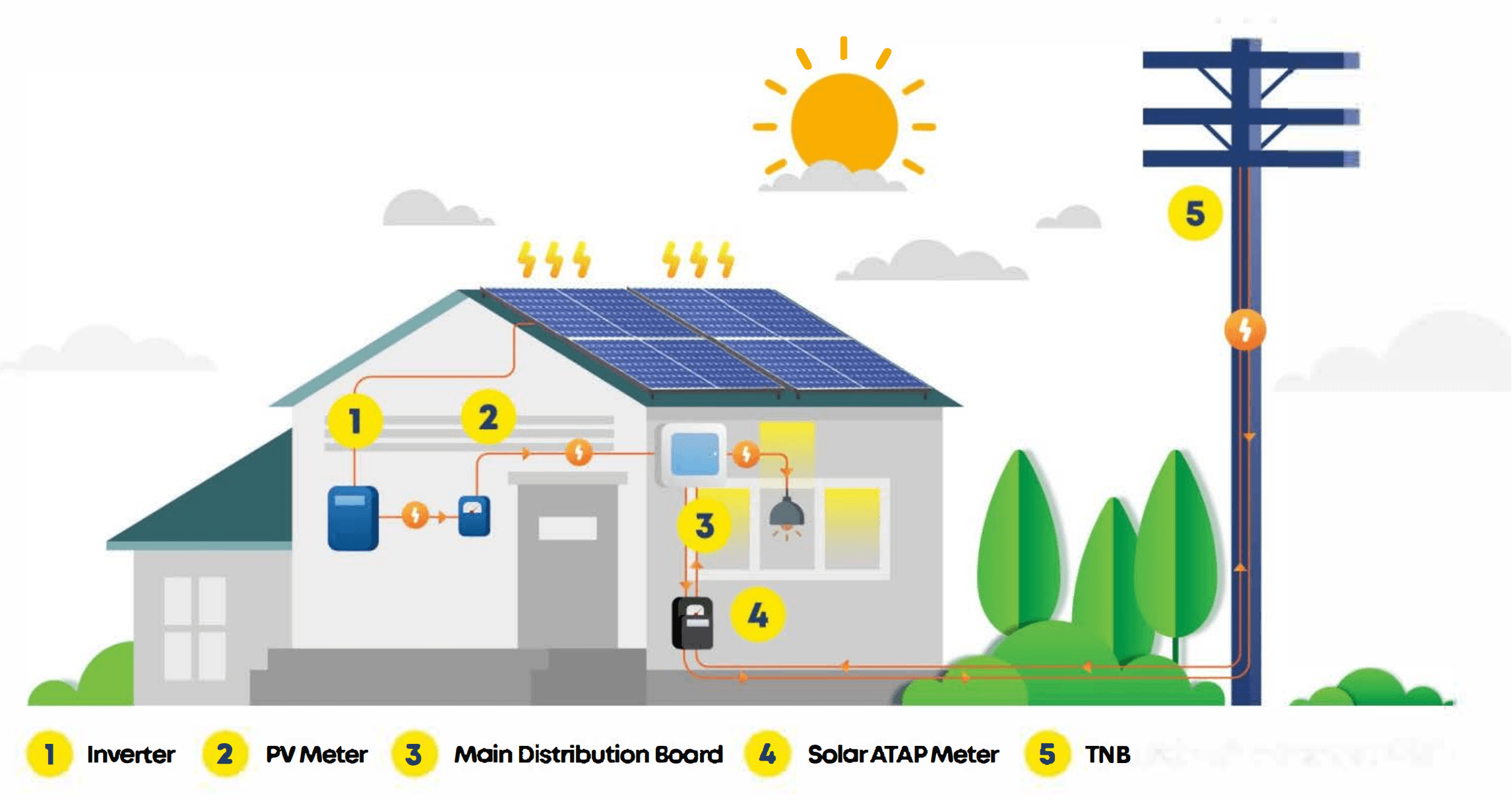
Source: TNB Malaysia (mytnb.com.my)
Solar ATAP Rules & System Limits
Every category of connection, size cap, and key restriction in one place.
| Parameter | Single-Phase (Residential) | Three-Phase |
|---|---|---|
| Maximum system size | ≤5 kWac (CCC required if >5kW) | ≤15 kWac domestic / Up to 1,000 kWac (1 MW) non-domestic |
| Connection voltage | 230V single-phase | 400V three-phase |
| Eligible premises | Landed homes, terrace houses, semi-D, bungalows (individual meters only) | Commercial, industrial, institutions — up to 100% of Maximum Demand |
| Export credit rate (Domestic) | Energy Charge rate per kWh (per TNB tariff) | Energy Charge rate per kWh (per TNB tariff) |
| Export credit rate (Non-Domestic) | N/A | Average SMP (System Marginal Price) — market-linked |
| Credit carry-forward | No — forfeited if unused at end of billing period | No — forfeited if unused at end of billing period |
| Cash payout of credits | No | No |
| Contract duration (max) | 10 years from Commencement Date | 10 years from Commencement Date |
| BESS (battery storage) | Allowed | Allowed |
| Solar carparks eligible | N/A (same compound) | Yes (same compound) |
| Covered pedestrian walkways | N/A (same compound) | Yes (same compound) |
| Multi-tenant buildings | NOT eligible | NOT eligible |
| National capacity cap | None — open quota | None — open quota |
MAQ Formula (Maximum Allowable Quantity)
The MAQ caps how much energy can receive export credits per billing period. Any export above the MAQ is accepted by TNB but earns zero credit.
Example: A 5 kWac system on a 30-day billing cycle: 5 × 5 × 30 = 750 kWh MAQ. This means up to 750 kWh of export earns credits each month. Size your system so generation does not materially exceed your consumption + MAQ to avoid forfeiture.
| Assessment Type | When Required | Notes |
|---|---|---|
| CCC (Connection Capacity Check) | Domestic systems — required if system exceeds standard limits (domestic <72kW) | Confirms grid capacity at your connection point |
| CAS (Circuit Assessment Study) | Non-domestic / >72kW LV connections | Required for commercial & industrial under 425kW |
| PSS (Power System Study) | HV connections >425kW | For large industrial; study fee applies (RM 15,000+) |
Important Exclusions (Official GP/ST/No. 60/2025)
- • Multi-tenant buildings (condominiums, apartments, flats, stratified properties) are NOT eligible.
- • Properties already on NEM 1.0, NEM 2.0, NEM 3.0, or SELCO must terminate first.
- • Systems must be installed by a SEDA-registered RPVSP (Registered PV Service Provider). DIY is not accepted.
- • Only one ATAP account per TNB meter account is permitted.
- • Installation must be on the same compound as the TNB meter (rooftop, carpark, or covered walkway).
Solar ATAP Credit Rates Explained
Domestic consumers earn credits at the Energy Charge rate. Non-domestic earn at the Average SMP — and credits do NOT carry forward.
Domestic (Residential)
Energy Charge Rate (per kWh)
Export credits are calculated at the prevailing TNB Energy Charge rate applicable to your tariff category. For Domestic (Tariff A) consumers, this is the tiered energy rate on your bill — so the more you consume, the higher your marginal rate and the more valuable your export credits.
Example: Domestic Tariff A, 201–300 kWh block
Credit at applicable Energy Charge rate
Non-Domestic (Commercial/Industrial)
Average SMP (System Marginal Price)
Non-domestic consumers are credited at the Average SMP — the market-based wholesale electricity price set by the grid operator. This replaces the fixed energy charge credit used in NEM 3.0 for B2B customers. SMP varies monthly based on grid dispatch costs.
Key implication for businesses
Primary value = self-consumption displacement of expensive MD/commercial tariff, not export
CRITICAL: Credits Do NOT Carry Forward
Under Solar ATAP (GP/ST/No. 60/2025), any unused export credits at the end of a billing period are forfeited permanently. They do not roll over to the following month and cannot be cashed out. This is a fundamental change from what many NEM users expected.
Implication: Over-sizing your system beyond your actual consumption is financially wasteful. The MAQ formula above is critical for right-sizing. Battery storage (BESS) is the recommended solution to capture surplus generation instead of losing it.
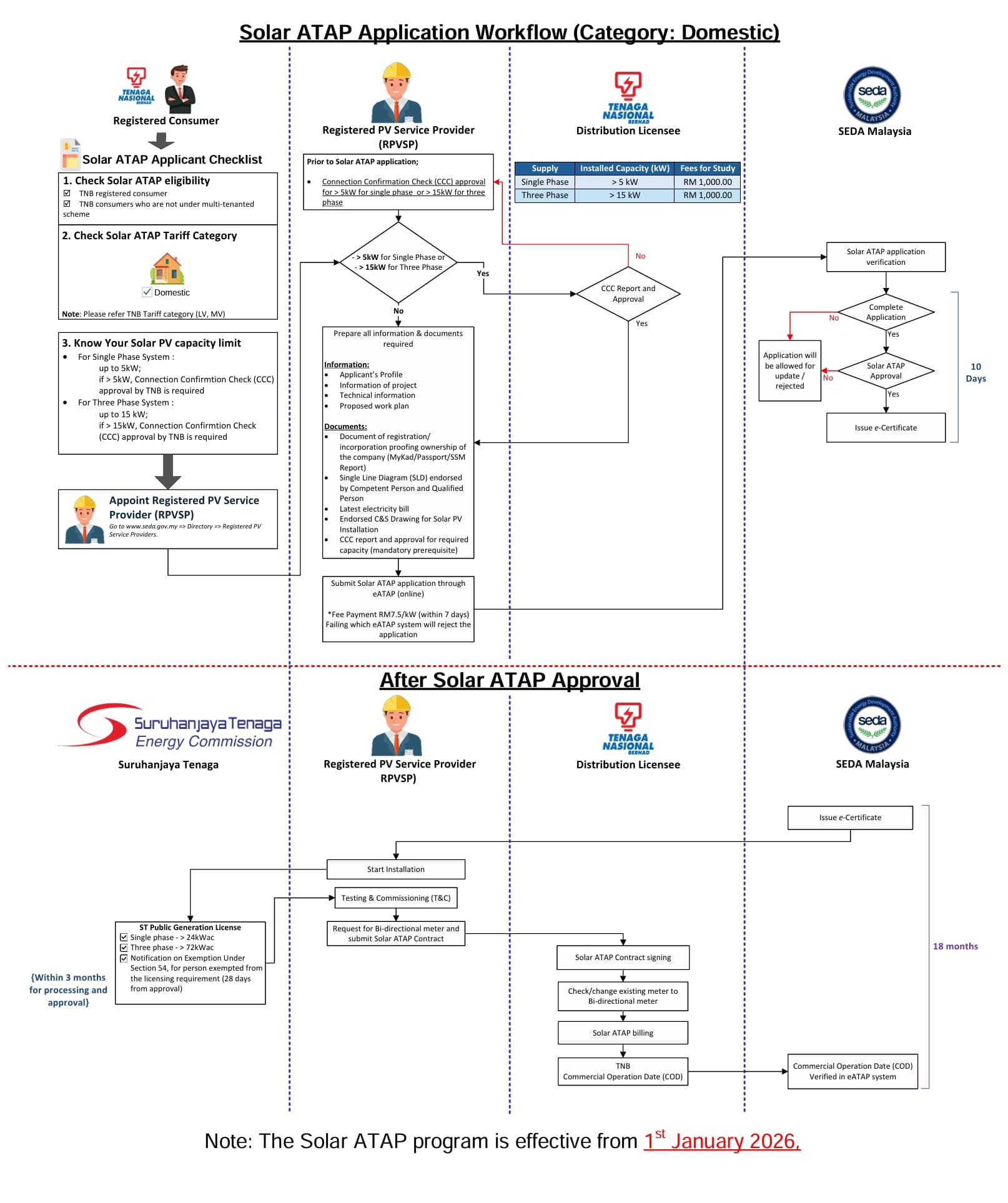
Domestic billing flow — Source: TNB Malaysia (mytnb.com.my)
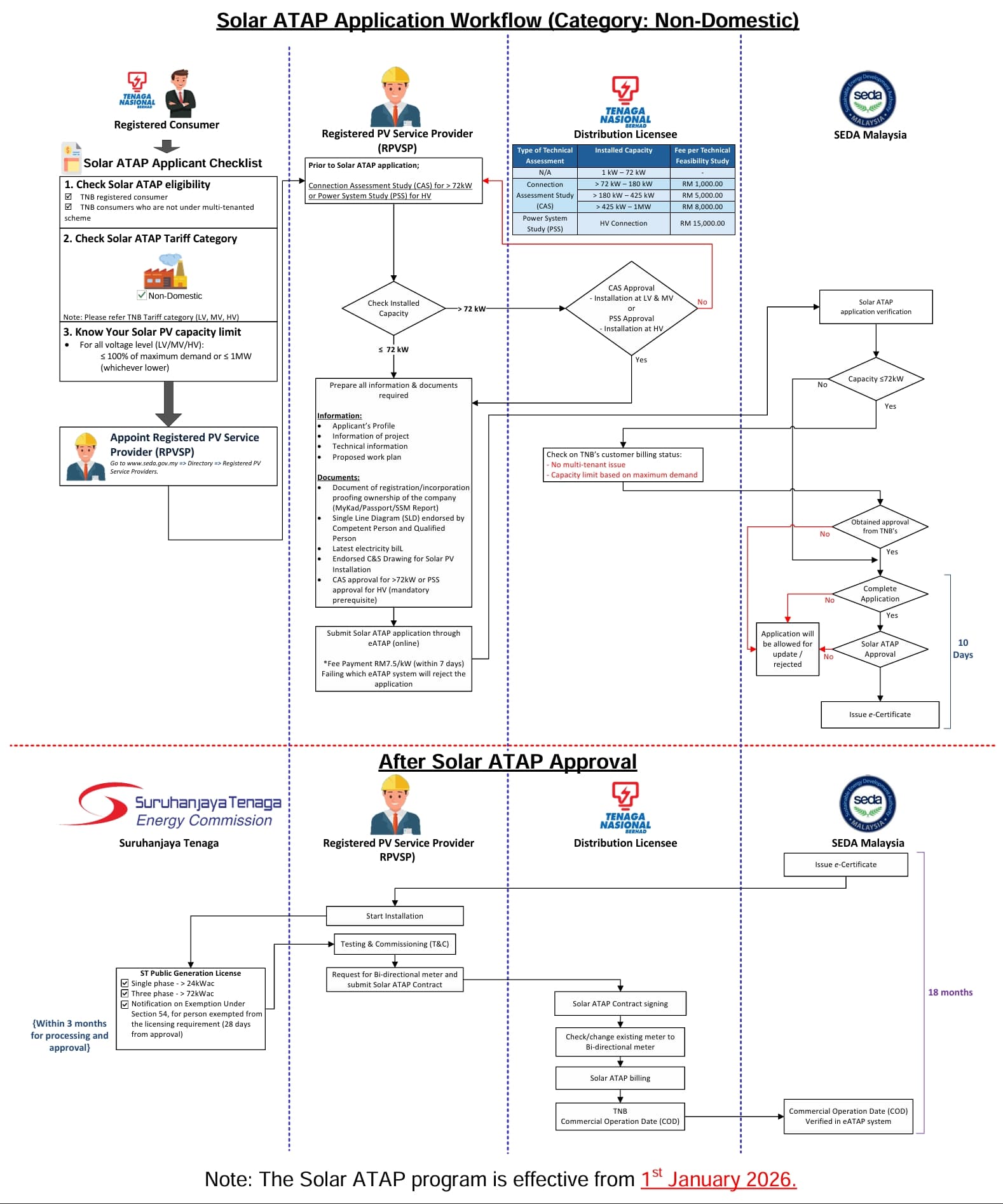
Non-domestic billing flow — Source: TNB Malaysia (mytnb.com.my)
For non-domestic consumers, the primary economic argument is Maximum Demand (MD) charge reduction — at RM 89.27/kW for MV/HV tariffs, shaving peak demand with solar generates far more savings than export credits alone.
Solar ATAP vs NEM 3.0: Full Comparison
What changed, what stayed the same, and who benefits more under ATAP.
| Feature | NEM 3.0 (Old) | Solar ATAP 2026 (New) |
|---|---|---|
| Start date | 2022–2024 | 1 January 2026 (GP/ST/No. 60/2025) |
| Programme status | Closed (quota exhausted) | Open — no quota |
| Domestic export credit rate | Near 1:1 parity (full tariff rate) | Energy Charge rate per kWh only (lower than NEM) |
| Non-domestic export credit rate | Energy Charge rate (fixed) | Average SMP — market-linked (lower, variable) |
| Credit carry-forward | Yes — rolled to next month | No — forfeited if unused |
| National quota cap | 450 MW — fully subscribed | None — open applications |
| Cash payout | No | No |
| Contract duration (max) | 10 years | 10 years from Commencement Date |
| Solar carparks eligible | No | Yes (same compound) |
| Covered walkways eligible | No | Yes (same compound) |
| BESS (battery storage) | Allowed | Allowed — highly recommended |
| Multi-tenant buildings | Not eligible | NOT eligible |
| Max single-phase domestic | 5 kWac | ≤5 kWac (CCC if exceeding) |
| Max three-phase domestic | 15 kWac | ≤15 kWac |
| Max non-domestic | 1 MWac | Up to 1,000 kWac (100% of MD) |
| Technical assessment | CCC / PSS | CCC (domestic <72kW) / CAS (>72kW) / PSS (HV >425kW) |
| Application portal | eSEDA | eSEDA via RPVSP |
| Governing body | SEDA Malaysia | Suruhanjaya Tenaga + SEDA Malaysia |
Biggest Win for Homeowners
The premium RM0.37/kWh rate for high-consumption households is 54% higher than what the same property would have earned under NEM 3.0. If your bill regularly exceeds RM400/month, ATAP is materially better.
Biggest Win for Businesses
Solar carparks and covered walkways are now eligible, enabling commercial properties without sufficient rooftop space to participate. Large factories and warehouses can now go up to 1 MWac.
Watch Out: No Carry-Forward
Unlike NEM 3.0, which rolled credits forward, ATAP credits expire at month-end. If your system over-generates in April (low bills, holidays), those credits are lost. This is the strongest economic case for adding battery storage.
Solar ATAP Savings Calculator
Adjust system size and monthly bill to see your estimated monthly credit and payback period.
ATAP Savings Estimator
Based on 4.5 peak sun hours/day (Peninsular Malaysia average)
Monthly Generation
675 kWh
Export Rate Applied
RM 0.27/kWh
Standard tier
Monthly Credit
RM 232
Est. Payback
8.1 yrs
Assumptions: 60% export ratio, 40% self-consumption, RM4,500/kW installed cost, TNB RP4 tariff at RM0.454/kWh for self-consumed units. Actual savings depend on your usage pattern and roof orientation. For a precise quote, request a RM100 priority site visit (fully credited when you proceed).
Want a more detailed analysis including roof orientation, shading factors, and financing options? Try our full solar savings calculator or explore our solar financing options.
Solar ATAP Application Process
Official process: must go via a RPVSP (Registered PV Service Provider) → SEDA → TNB. From first call to first credit — 7 steps with Trexon as your RPVSP.
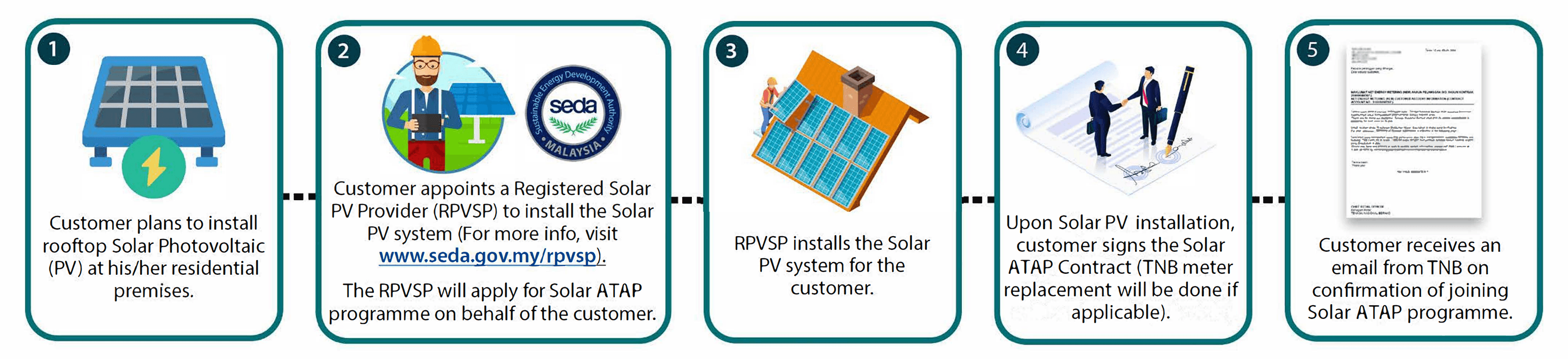
Official application journey — Source: TNB Malaysia (mytnb.com.my)
RM100 Priority Site Visit
1–2 days to scheduleA Trexon engineer visits your property to assess roof area, orientation, shading, structural suitability, and your TNB meter configuration. We also review 12 months of your electricity bills to determine your consumption tier and optimal system size.
Book RM100 visit (fully credited)System Design & Quotation
2–3 business daysBased on the site assessment, we design your system — number and placement of panels, inverter specification, cabling routes, and battery storage recommendations. You receive a detailed written quotation including projected savings, payback period, and ATAP eligibility confirmation.
SEDA Registration via RPVSP
1–2 weeksAs a SEDA-registered RPVSP (Registered PV Service Provider), Trexon submits the ATAP application via eSEDA on your behalf. Application forms are sourced from the SEDA portal (seda.gov.my). We prepare all technical documents: single-line diagram, equipment specifications, RPVSP certification, and premises details. SEDA assigns a reference number and conducts technical review.
TNB Application
1–3 weeksOnce SEDA approves, Trexon submits a parallel application to TNB for grid interconnection approval. TNB reviews the application to ensure the system will not overload your local distribution network. Approval in principle (AIP) is issued.
Installation
3–5 working daysOur CIDB-certified installation team completes the full physical installation: mounting structure, solar panels, DC/AC wiring, inverter, consumer unit upgrades if needed, and earthing. All work complies with the Electricity Supply Act 1990 and MS IEC standards.
TNB Commissioning & Meter Change
2–4 weeks after installationTNB conducts a final inspection and replaces your existing meter with a certified bi-directional smart meter that separately tracks import and export energy. This is the final technical step before your ATAP contract activates.
Start Earning Credits
From first billing cycleYour ATAP contract is activated. From the next TNB billing cycle, your electricity bill will show both your import charges and your export credits. Trexon provides a monitoring app link so you can track daily generation, self-consumption, and export in real time.
Total timeline: From first contact to first credit, the typical end-to-end timeline is 8–12 weeks. The longest single step is usually the TNB meter change, which depends on TNB scheduling. Trexon proactively follows up with TNB on your behalf to minimise delays.
ROI Scenarios: Real Payback Numbers
Three common household profiles with realistic savings projections under Solar ATAP 2026.
| Profile | Monthly Bill | System Size | Est. System Cost | Export Rate Tier | Monthly Saving | Payback |
|---|---|---|---|---|---|---|
| Medium Home | RM 300 | 5 kW | RM 22,500 | RM 0.27/kWh | RM 250 | 7.5 yrs |
| Large Home | RM 500 | 8 kW | RM 33,600 | RM 0.27/kWh | RM 400 | 7.0 yrs |
| High-Usage Home | RM 1,000 | 12 kW | RM 48,000 | RM 0.37/kWh | RM 850 | 4.7 yrs |
| High-Usage Bungalow | RM 1,500 | 15 kW | RM 58,500 | RM 0.37/kWh | RM 1,200 | 4.1 yrs |
System lasts 25+ years
Panels carry a 25-year performance warranty. After the 10-year ATAP contract, you still own a functioning system generating free electricity for 15+ more years.
TNB tariff risk hedge
RP4 tariff increased 13.64% in Jan 2026. Every future tariff hike increases the value of your solar system — payback periods shrink as grid electricity gets more expensive.
Property value uplift
Studies show solar installations increase property resale value by 3–5%. The ATAP contract is transferable to new property owners.
Explore system-specific guides: 5 kW system, 8 kW system, 12 kW system.
What Happens After the 10-Year Contract?
Your solar journey does not end when the ATAP contract expires.
When your 10-year Solar ATAP contract expires, your system enters self-consumption mode. This means your solar panels continue to generate electricity and offset your TNB bill — but any excess exported to the grid earns zero export credit.
What still works after Year 10
- Panels continue generating electricity (25-year warranty)
- Self-consumed electricity still displaces grid imports
- Battery storage captures surplus instead of wasting it
- Inverter can be upgraded for new programmes
- You may be eligible to apply for ATAP's successor programme
What stops after Year 10
- Export credits — excess energy goes to grid at RM0
- ATAP contract terms no longer apply
- Bi-directional meter may revert to standard metering
Critically, your system will have already paid itself back within 4–8 years depending on your profile. Years 8–25+ are pure profit — essentially free electricity for 15+ years after the payback period. The total lifetime value of a 5 kW system installed in 2026 is estimated at RM 60,000–RM 90,000 in electricity cost displacement over 25 years, assuming 3% annual tariff increases.
Why the Monthly Credit Reset Makes Batteries Essential
ATAP's use-it-or-lose-it design has created the strongest economic case yet for battery storage in Malaysia.
Under Solar ATAP, unused export credits expire at the end of each month — unlike the old NEM 3.0 scheme, where credits rolled forward. For most households, this means significant energy is lost during low-consumption periods: school holidays, Raya, Christmas, or any month where the family travels.
A home battery storage system — such as a 10 kWh lithium iron phosphate (LFP) unit — charges from surplus solar during the day and discharges at night. This effectively converts wasted export into usable self-consumption, eliminating the need to draw from the TNB grid after sunset.
| Scenario | Without Battery | With 10 kWh Battery |
|---|---|---|
| Self-consumption ratio | 35–40% | 70–80% |
| Monthly lost credits (holiday month) | RM 60–120 | RM 5–15 |
| Night grid imports | Full night usage from TNB | Minimal — battery covers 6–8 hrs |
| Annual saving increase | Baseline | +RM 1,500–2,500/year |
| Battery payback period (RM 15,000 unit) | — | 6–10 years |
Battery prices in Malaysia have fallen ~40% since 2022. A 10 kWh LFP system now costs approximately RM 12,000–18,000 installed, with a 10-year warranty and 6,000+ charge cycle lifespan. When combined with ATAP, the combined system payback is typically 5–7 years, and the financial case strengthens with every TNB tariff increase.
Solar ATAP Eligibility Checklist
Check every item before submitting your application.
You ARE eligible if:
- Your premises is served by TNB (Peninsular Malaysia or Labuan)
- You are a TNB account holder (residential or commercial)
- Your property is a single-title, landed home or commercial building
- You do not currently hold an active NEM 1.0 / 2.0 / 3.0 or SELCO contract
- Your roof (or carpark/walkway canopy) has sufficient unshaded area
- The building structure can safely support solar panel mounting
- You are installing through a SEDA-registered contractor (Trexon is registered)
- Your single-phase system does not exceed 5 kWac
- Your three-phase system does not exceed 15 kWac (residential) or 1 MWac (commercial)
You are NOT eligible if:
- Your property is a multi-tenant building (condo, apartment, flat, SOHO)
- You already have an active NEM or SELCO contract (must wait for expiry)
- Your premises is in Sabah (SESB jurisdiction) — apply for SESB NEM instead
- Your premises is in Sarawak (SEB jurisdiction) — apply for NEM Sarawak instead
- You are renting and the TNB account is not in your name (owner consent required)
- Your building is under a strata title with shared TNB metering
- The proposed system size exceeds your connection category limits
- Your premises has outstanding TNB arrears
Not sure about your eligibility? Contact Trexon for a free eligibility check. We review your TNB account, property type, and roof suitability before submitting any applications — so there are no wasted fees or delays. Check eligibility now →
Required Documents for Solar ATAP Application
Prepare these before Trexon submits your SEDA and TNB applications.
Residential Applicants
- MyKad (NRIC) — front and back copy
- Latest 3 months TNB electricity bills
- TNB account number
- Proof of ownership (Grant, Geran, SPA, or quit rent receipt)
- Site photographs (Trexon will take during assessment)
- Single-line diagram (prepared by Trexon)
- Product data sheets for panels and inverter (provided by Trexon)
- Trexon installer registration certificate (provided by Trexon)
- Signed ATAP application consent form
Commercial Applicants (Additional)
- Company registration (SSM Form 9 / Form 13 / Form 24 / Form 49)
- Company director MyKad copy
- Board resolution authorising ATAP application
- Business registration / operating licence
- Latest 12 months TNB electricity bills (to confirm consumption tier)
- Structural engineering report (for rooftop above 15 kW)
- Building plan approval (MBPJ / MBSA / DBKL etc.)
- Signed TNB grid interconnection application
- Trexon engineering proposal and system design report
Trexon handles most of this for you. We prepare the single-line diagram, equipment datasheets, installer registration certificates, and all SEDA/TNB submission forms. You only need to provide ownership documents, NRIC copies, and TNB bills. Our team will guide you through each step.
TNB RP4 Tariff: Why Solar Payback Got Shorter in 2026
The January 2026 TNB tariff revision makes solar the most financially compelling it has ever been in Malaysia.
On 1 January 2026, TNB implemented the fourth regulatory period (RP4) tariff revision under Malaysia's Incentive-Based Regulation (IBR) framework. The residential tariff for the first 200 kWh block increased to approximately 45.40 sen/kWh — a 13.64% increase from the RP3 rate.
RP3 Rate (until Dec 2025)
39.95 sen/kWh
RP4 Rate (from Jan 2026)
45.40 sen/kWh
Rate increase
+13.64%
Why does this matter for solar? Every unit of electricity your solar panels generate and self-consume is worth RM0.454 in avoided TNB charges (up from RM0.40 under RP3). For a 5 kW system self-consuming 200 kWh/month, this tariff increase alone adds RM 10.80/month to the implicit saving — enough to shave 4–6 months off your payback period.
Looking forward, analysts expect TNB tariffs to continue rising under RP5 (expected 2029) and beyond, as Malaysia phases out natural gas subsidies and integrates higher renewable energy costs. Installing solar in 2026 locks in your payback calculation at today's tariff rates — every future increase makes your system more valuable.
For a broader view of Malaysian solar incentives including the RM1,000 rebate, GITA tax incentives, and green SRI sukuk, see our Solar Incentives Malaysia guide.
Ready to Apply for Solar ATAP?
Trexon is a SEDA-registered Solar ATAP contractor. We handle your entire application — SEDA registration, TNB interconnection, meter change, and commissioning. Book the RM100 priority site visit today; the full RM100 is credited when you proceed, and your ATAP application can progress within 8–12 weeks.
Or call us directly: +60 12-770 7249 — Mon to Sat, 9am–6pm