Model your project savings and peak-demand reduction
Calculate ROISmart Lighting.
Can Save 60-80% (site dependent).
Motion-activated LED systems with IoT cloud control. Auto-dims to 30% standby when unoccupied, instantly brightens to 100% on detection.
See It In Action
Motion Detection System
Calculate Your ROI
See exact energy and cost savings for your facility
T8 Fluorescent
Legacy System
- Flicker rate: 75%
- Frequent failures
- High maintenance
- Poor light quality
Standard LED
Basic Upgrade
- About 62% energy savings vs T8
- Longer lifespan
- Moderate flicker
- No smart control
Smart LED System
Illustrative configuration (priced per site)
- Motion-activated dimming
- 30% standby / 100% active
- Flicker-free (<5%)
- IoT cloud monitoring
- 190 lm/W efficiency
- MyHIJAU-listed models
Illustrative example (default inputs)
Technical Specifications
Smart Lighting Technology for Malaysian Commercial Facilities
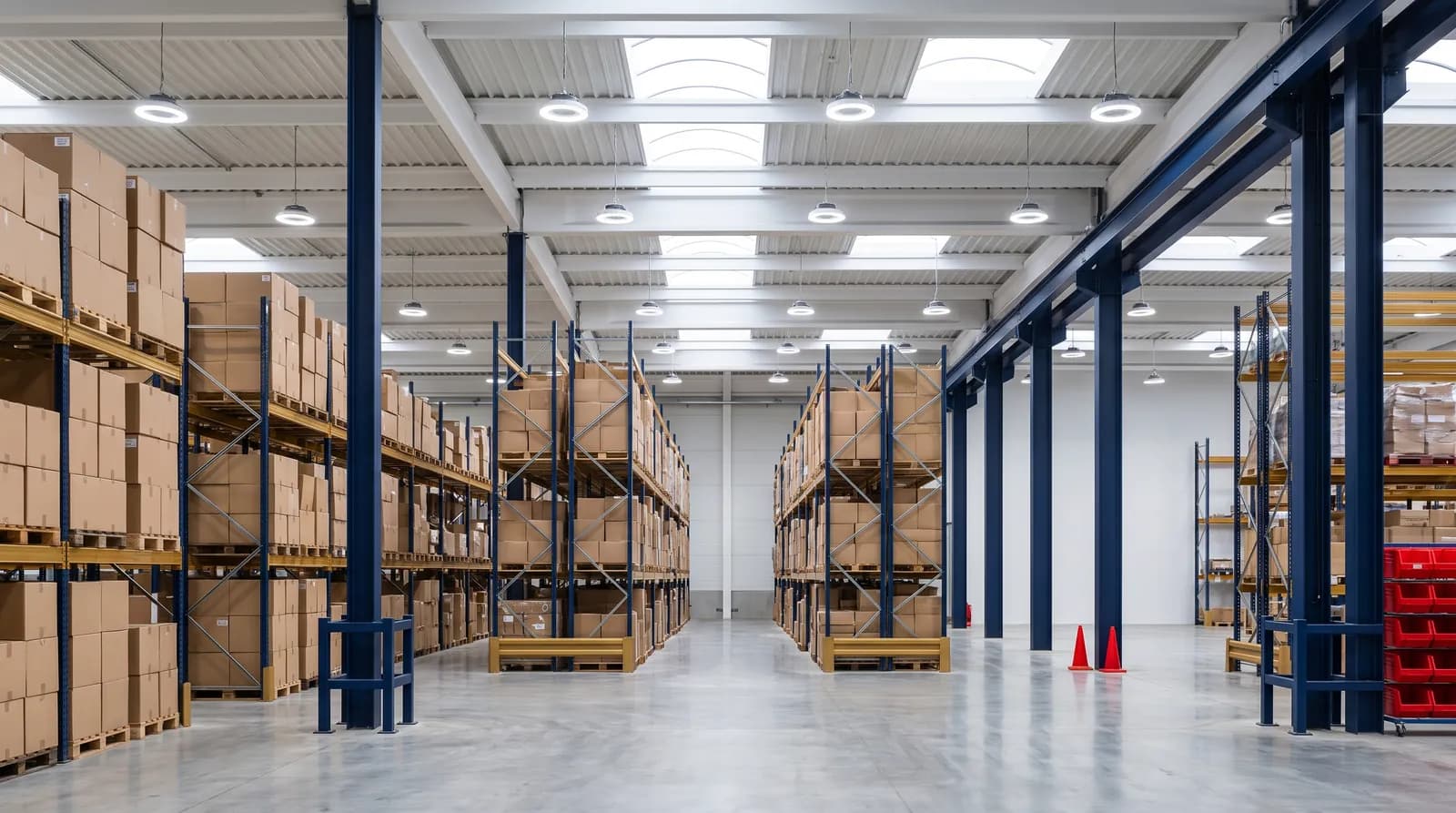
Smart lighting combines high-efficiency LED technology with intelligent control systems to deliver energy savings far beyond a simple lamp swap. A conventional T8 fluorescent fixture draws 58W and runs at full power regardless of whether a space is occupied. A Trexon Smart LED equivalent draws 20W at full brightness — and automatically dims to 6W (30% power) when the space is unoccupied, then brightens instantly upon motion detection. For a Malaysian warehouse operating 24 hours, this motion-based dimming strategy often reduces lighting energy consumption by 60-80% or more depending on controls, with the exact saving depending on actual occupancy patterns throughout the day.
Four core technologies drive smart lighting performance. LED retrofit replaces fluorescent and metal halide sources with chips delivering 190 lumens per watt — nearly double the efficacy of T8 fluorescent at 100 lm/W. Motion sensors using passive infrared (PIR) or microwave detection trigger full brightness within milliseconds of occupancy, eliminating the "lights on in empty rooms" waste that accounts for 30-50% of lighting energy in carparks, warehouses, and office corridors. Daylight harvesting uses photosensors to automatically reduce artificial light output when sufficient natural daylight is available — cutting daytime lighting loads in perimeter offices and atrium spaces by 40-60%. Lux-level optimisation calibrates each fixture to the minimum light level required by MS 1525 standards for the specific task: 300–500 lux for general office work, 150 lux for warehouse aisles, 50 lux for carpark driving lanes. Fixtures are specified from MyHIJAU-listed models (confirmed per model); GITA eligibility is subject to MGTC approval, and green bank financing terms are set by your own bank.
Smart Lighting FAQ
How much can smart LED lighting save on TNB bills in Malaysia?
Smart LED systems with motion-activated dimming often save 60-80% or more (depending on controls and occupancy) compared to T8 fluorescent baselines in Malaysian commercial facilities. A 50,000 sqft warehouse with 500 T8 fixtures (58 W) running 24 hours uses about 254,000 kWh a year for lighting — about RM 128,700 at the Low Voltage rate of RM 0.5068/kWh (use your own tariff). At 60-80% savings that is about RM 77,000-103,000 a year, so the simple payback on a RM 140,000 upgrade (500 fixtures at RM 280 each) is about 1.4-1.8 years before GITA; GITA (worth up to 14.4% of qualifying capex once fully used) shortens it further.
What is daylight harvesting and is it worth implementing in Malaysia?
Daylight harvesting uses photosensors to measure ambient light levels and automatically reduce artificial lighting output when natural light is sufficient. In Malaysia, with 12 hours of strong daylight year-round, perimeter offices and top-floor factory spaces can reduce daytime lighting energy by 40-60% through harvesting alone. Combined with motion sensing, total lighting energy reduction reaches 70-80% in well-daylit spaces. The technology adds approximately RM 50 per fixture to implementation cost but delivers the highest ROI in facilities with large window areas or skylights — common in industrial parks in Shah Alam, Petaling Jaya, and Johor Bahru.
Does smart lighting qualify for GITA tax incentives in Malaysia?
Yes, if the equipment qualifies. LED lighting retrofits and smart lighting control systems using MyHIJAU-listed equipment can qualify for the Green Investment Tax Allowance (GITA) Tier 2: a 60% allowance on qualifying capital expenditure, set off against up to 70% of statutory income. For a company paying 24% corporate tax on a RM 200,000 lighting upgrade, that is worth up to RM 28,800 in tax — 14.4% of the project cost — once fully used. The GITA (Asset) application is submitted to MGTC (MyHIJAU) after commissioning and must be commissioned and submitted by 31 December 2026; subject to MGTC verification. Trexon prepares the GITA documentation, including the MyHIJAU listing details of the equipment supplied, equipment specifications and the energy audit report.
What lux levels are required for Malaysian workplaces under MS 1525?
MS 1525:2019 (Code of Practice on Energy Efficiency and Use of Renewable Energy for Non-Residential Buildings) sets minimum illuminance levels: General office open plan requires 500 lux; private offices 300 lux; corridors and lobbies 100 lux; warehouse general storage 150 lux; warehouse picking and packing 300 lux; manufacturing fine assembly 750 lux; carpark driving aisles 50 lux; carpark parking bays 75 lux. Smart lighting systems are programmed to maintain these minimums while dimming to the lowest compliant level, maximising energy savings without compromising visual comfort or DOSH safety compliance.
How long does a smart lighting installation take and is there disruption?
Installation time depends on fixture count and facility type. Work proceeds zone by zone so only one area is offline at a time — operations continue in all other areas. For 24-hour manufacturing facilities, installation is sequenced during lower-production shifts so there is no total lighting outage. Electrical connections need brief circuit isolations at each distribution board, followed by IoT commissioning and lux calibration. The schedule is set in your proposal.
Ready to Upgrade Your Lighting?
Get a detailed lighting audit and customized proposal with exact ROI calculations for your facility. GITA tax incentive may apply, subject to MGTC verification.
LED vs Fluorescent: Full Cost Comparison
Malaysian commercial buildings still running T8 fluorescent fixtures pay 2–3× more for lighting than they need to. Here is the honest, complete picture.
| Criteria | T8 Fluorescent | Standard LED | Smart LED (Recommended) |
|---|---|---|---|
| Wattage per fixture | 36–58 W | 18–22 W | 15–20 W |
| Lifespan | 8,000–12,000 hrs | 30,000–50,000 hrs | 50,000–75,000 hrs |
| Lumen output (2 ft) | 2,700 lm | 2,800 lm | 3,000 lm |
| Energy cost per fixture (10 hrs/day, 365 days, RM 0.5068/kWh) | RM 67–107 | RM 33–41 | RM 28–37 |
| Dimming / occupancy control | None | Limited | Full IoT + DALI |
| Maintenance (ballast/tube) | Every 1–2 yrs | Every 5–8 yrs | Every 8–12 yrs |
| Heat output (IR) | High (UV risk) | Low | Very low |
| GITA / MyHIJAU eligible | No | Partial | Possible — 60% if listed (subject to MGTC verification) |
| Payback vs T8 | — | Depends on hours | Depends on hours |
Illustrative ROI Example: 5,000 sqft Kuala Lumpur Office
A typical mid-sized KL office floor with 80 T8 fluorescent fixtures running 11 hours a day, 26 days a month.
Over 10 years, this single office floor saves RM 60,500. Combine with commercial solar to cut your energy cost further.
Malaysian Commercial Lighting Standards (MS 1525:2019)
The Malaysian Standard MS 1525:2019 (Code of Practice on Energy Efficiency and Use of Renewable Energy for Non-Residential Buildings) sets minimum requirements for commercial lighting. Non-compliance risks failing your Green Building Index (GBI) assessment and GITA tax incentive eligibility.
Source: MS 1525:2019, ASHRAE 90.1 (reference standard). Designs target MS 1525:2019 requirements; compliance is confirmed for each project by a qualified consultant.
Commercial Office Tower — 14-Storey Retrofit
An illustrative 14-floor office building retrofitted from T8 fluorescent to IoT-enabled Smart LED across 68,000 sqft of lettable area (2,240 × 58 W fixtures, 11 hours a day, 26 days a month, RM 0.5068/kWh).
A building owner could qualify for the GITA 60% investment tax allowance on the RM 430,000 upgrade — a RM 258,000 allowance worth up to RM 61,920 in tax at the 24% corporate rate (subject to MGTC verification). An IoT dashboard tracks per-floor consumption and shows zones for further optimisation. See all energy efficiency solutions.
Ready to calculate your lighting upgrade ROI?
Smart LED works well with solar — your panels generate part of the electricity your lights consume, cutting your net energy cost further.
Explore Energy Efficiency Solutions
Get a Smart Lighting Proposal
Tell us about your facility and we'll design a smart LED lighting solution.
- Sizing from your 12 months of TNB bills and shift pattern
- Roof, switchboard and single-line diagram reviewed by our engineers
- Available incentives (GITA for solar, subject to MGTC verification) and Solar ATAP eligibility checked for your premises
- SEDA-registered PV Service Provider (RPVSP-2026/373) · SSM 201301044881 (1074704-D)
Prefer to talk first? Message our commercial team on WhatsApp.
WhatsApp Us