Model your project savings and peak-demand reduction
Calculate ROISolar Energy for Data Centres Malaysia
Malaysia is a major ASEAN data centre market — and electricity is one of your biggest costs. Meet RE100 and ESG commitments from hyperscaler tenants while lowering energy bills with on-site solar and off-site renewable procurement such as CGPP.
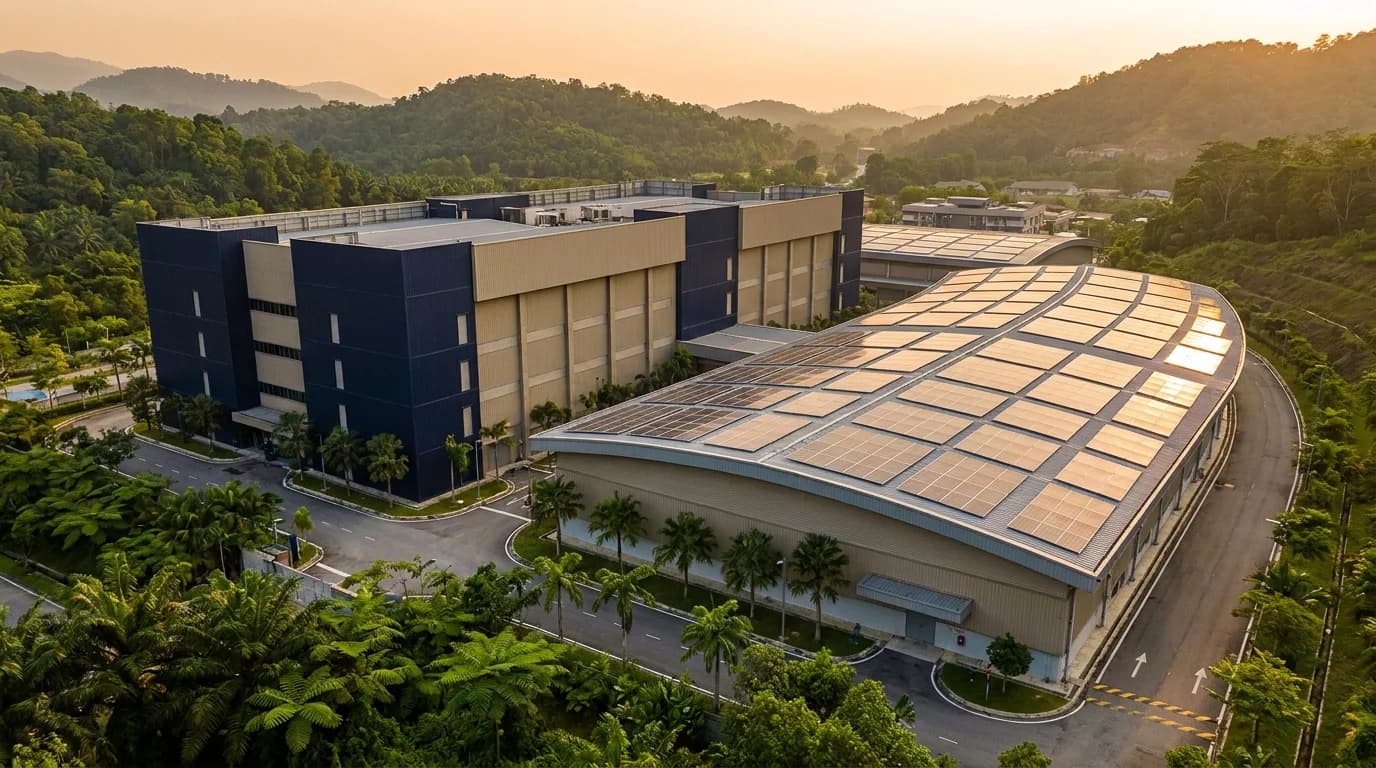
Illustrative solar concept. Site design follows engineering assessment.
Why Malaysian Data Centres Are Going Solar
Three structural forces are making renewable energy non-negotiable for data centre operators in Malaysia.
Malaysia Is ASEAN's Data Centre Hub
Johor, KL, and Penang host a fast-growing number of operational and committed data centres. Hyperscalers — AWS, Google, Microsoft, ByteDance — have announced billions in Malaysian DC investment. With that scale comes enormous electricity demand and intense scrutiny on its source.
Hyperscalers Demand Green Power
RE100 signatories — including the world's largest cloud providers and tech firms — require their colocation and supply chain partners to demonstrate renewable energy use. Without a credible RE strategy, Malaysian data centres risk losing tenants to competitors in regions with better green power access.
Electricity Is a Major OpEx Line
For most data centres, electricity is one of the largest operating costs. On-site solar is one tool to reduce this structural cost burden, alongside storage and efficiency measures.
Three Solar Models for Data Centres
Each model addresses different constraints — roof area, scale, and RE100 ambition. Most large data centres use a combination.
Rooftop Solar
Maximise available roof area with high-efficiency bifacial panels. Typical data centre roofs yield 300 kWp to 2 MWp depending on footprint. Suited to initial RE% improvement and on-site generation credentials.
On-site | Quick deploymentSolar Carport
Convert parking areas into solar generation assets. Dual purpose: shaded parking for staff and vehicles, plus clean energy for the facility. Adds meaningful generation capacity beyond the rooftop alone.
On-site | Additional capacityVirtual PPA / CGPP
Off-site renewable electricity contracted directly by the operator through Malaysia's Corporate Green Power Programme, with no roof limit. Trexon does not structure or broker CGPP agreements.
Off-site | Contracted by the operatorSolar + BESS for Data Centres
Battery Energy Storage Systems (BESS) are increasingly paired with data centre solar deployments. Unlike residential storage, data centre BESS is typically deployed at the facility level — 500 kWh to several MWh — to serve specific grid and operational functions.
BESS does not replace diesel generators or your primary UPS infrastructure. It works alongside them as an intelligent buffer between the grid and your critical load.
- Peak shaving: discharge during TNB peak periods to cut Maximum Demand (MD) charges
- Solar smoothing: buffer intermittent solar output for stable facility feed
- Demand management: reduce contracted demand capacity with TNB, lowering fixed charges
- UPS supplement: BESS can provide bridging power during diesel generator start-up
- Frequency regulation: BESS can participate in grid services programs if applicable
BESS + Diesel Generator Compatibility
Data centres rely on diesel gensets for N+1 or 2N backup. BESS integrates as an additional layer — not a replacement. The operational stack becomes:
MD Charge Savings Example (illustrative scenario)
A 10 MW data centre with 500 kWh BESS shaving 500 kW of peak demand saves approximately RM89.27/kW (MV General) × 500 kW = RM44,635/month in TNB Maximum Demand charges — over RM535K annually — before any energy savings from solar generation.
Typical System Sizing for Data Centres
On-site solar capacity is constrained by physical footprint. Virtual PPA removes that constraint for large facilities.
| DC Category | IT Load | Solar Capacity | RE Coverage | Est. Annual Savings |
|---|---|---|---|---|
| Edge / Small | 0.5 – 2 MW | 200 – 500 kWp | ~4-6% | RM76K – RM190K |
| Mid-Tier | 2 – 10 MW | 500 kWp – 2 MWp | ~3-4% | RM190K – RM760K |
| Large / Hyperscale | 10 – 50 MW | 1 – 5 MWp (on-site) | ~1.4% on-site + CGPP | RM380K – RM1.9M |
| Hyperscale + CGPP | 10 – 100+ MW | Not limited by roof (off-site) | Up to 100% RE | Depends on contract |
Indicative energy-charge savings at the MV General rate (RM0.2983/kWh), assuming 3.5 peak sun-hours and all output used on site; maximum-demand savings are not counted. Actual figures depend on system design and consumption profile.
Why Large Data Centres Look Beyond the Roof
On-site solar — even with every square metre of roof and carport covered — typically offsets only a low single-digit share of a large data centre's electricity consumption. A 20 MW facility running continuously uses about 175 GWh a year (20 MW × 8,760 h). 1-2 MWp of rooftop solar at 1,260 kWh/kWp/yr generates about 1.3-2.5 GWh, roughly 0.7-1.4% of annual load.
For RE100 compliance, data centres need a path to 100% renewable electricity. Malaysia's Corporate Green Power Programme (CGPP) enables this by allowing businesses to contract directly with licensed RE generators for power that flows into the national grid on their account.
Trexon does not structure or broker CGPP agreements. We design and install the on-site rooftop and carport solar and BESS; CGPP contracts, price terms and RE certificate issuance are agreed directly between the operator and the licensed generator.
No Physical Roof Limit
Procure as much renewable power as your load requires through off-site solar farms.
RE Certificates for Reporting
Receive official documentation for RE100, CDP, MSCI ESG, and TCFD Scope 2 reporting.
Long-Term Price Certainty
Long-term contracts can give price certainty against TNB tariff changes, on terms set by the generator.
Tenant-Facing Green Credentials
Offer hyperscaler tenants documented renewable energy supply — a key differentiator in the Malaysian DC market.
Combine with On-Site Solar
Stack on-site rooftop/carport solar with CGPP for a more complete RE strategy.
Data Centre Solar: Frequently Asked Questions
Common questions from data centre operators evaluating solar and RE100 strategies in Malaysia.
Can a data centre run entirely on solar power in Malaysia?
Not entirely from on-site solar alone — roof and carport areas are typically insufficient to cover the full load of a data centre running 24/7. However, on-site solar can be combined with off-site renewable procurement such as CGPP, contracted directly between the operator and a licensed generator, to reach 100% renewable electricity coverage. Trexon installs the on-site solar and BESS; it does not structure or broker CGPP or Virtual PPA contracts.
Will solar panels affect my data centre's power reliability?
Solar is integrated as a supplementary supply layer and does not replace your primary power feed or diesel backup generators. The solar system feeds into your common electrical infrastructure during daylight hours, reducing the load drawn from TNB. Inverters with anti-islanding protection ensure safe disconnection during grid outages, maintaining your critical power hierarchy (TNB → UPS → Diesel Gen).
What is Virtual PPA and how does it help data centres?
A Virtual PPA (also known as a Financial PPA or CGPP under Malaysia's Corporate Green Power Programme) allows a data centre to contractually purchase renewable energy from an off-site solar farm without physical power delivery. The data centre receives Renewable Energy Certificates (RECs) or equivalent documentation confirming that the equivalent amount of clean energy was injected into the grid on their behalf. This enables RE100 and ESG reporting without needing to install more panels than your roof can support. Trexon does not offer or broker Virtual PPAs; this is explained for planning purposes.
Does solar affect our Power Usage Effectiveness (PUE)?
Yes, positively. Solar reduces the amount of utility power consumed per unit of IT load. Since PUE = Total Facility Energy / IT Equipment Energy, reducing the total facility energy draw via on-site solar generation (which is not counted as consumed utility power in some PUE methodologies) can help improve your PUE ratio. This depends on how your facility measures and reports PUE.
What is the minimum data centre size for solar to be worthwhile?
On-site solar becomes financially meaningful for data centres with at least 500 kW of IT load and adequate roof or carport area. For smaller edge data centres, the economics still work but the percentage of load offset is lower. For any size data centre seeking RE100 compliance, off-site options such as CGPP can be considered regardless of physical site constraints.
How do we document solar for ESG and RE100 reporting?
Trexon provides metered generation reports and documentation compatible with RE100 technical criteria, GHG Protocol Scope 2 guidance, and TCFD disclosure requirements. For CGPP or Virtual PPA arrangements contracted by the operator, RECs are issued by the relevant authority and can be used for CDP, MSCI ESG, and sustainability report disclosures.
Ready to Build Your Data Centre RE Strategy?
Our team designs on-site solar and BESS for data centre operators. Request a quote tailored to your facility size and RE100 targets.
Get a Data Centre Solar Proposal
Tell us about your data centre and we'll design a suitable solar + BESS solution.
- Sizing from your 12 months of TNB bills and shift pattern
- Roof, switchboard and single-line diagram reviewed by our engineers
- Available incentives (GITA for solar, subject to MGTC verification) and Solar ATAP eligibility checked for your premises
- SEDA-registered PV Service Provider (RPVSP-2026/373) · SSM 201301044881 (1074704-D)
Prefer to talk first? Message our commercial team on WhatsApp.
WhatsApp UsRelated reading
Related Solutions
Battery Energy Storage (BESS)
Peak shaving, demand management, and UPS supplementation for data centres
Virtual PPA / CGPP
Procure 100% renewable electricity through Malaysia's Corporate Green Power Programme
CRESS (Corporate Renewable Energy Supply Scheme)
Direct renewable energy supply for large commercial and industrial consumers
Solar Carport
Dual-purpose solar structures for data centre parking areas