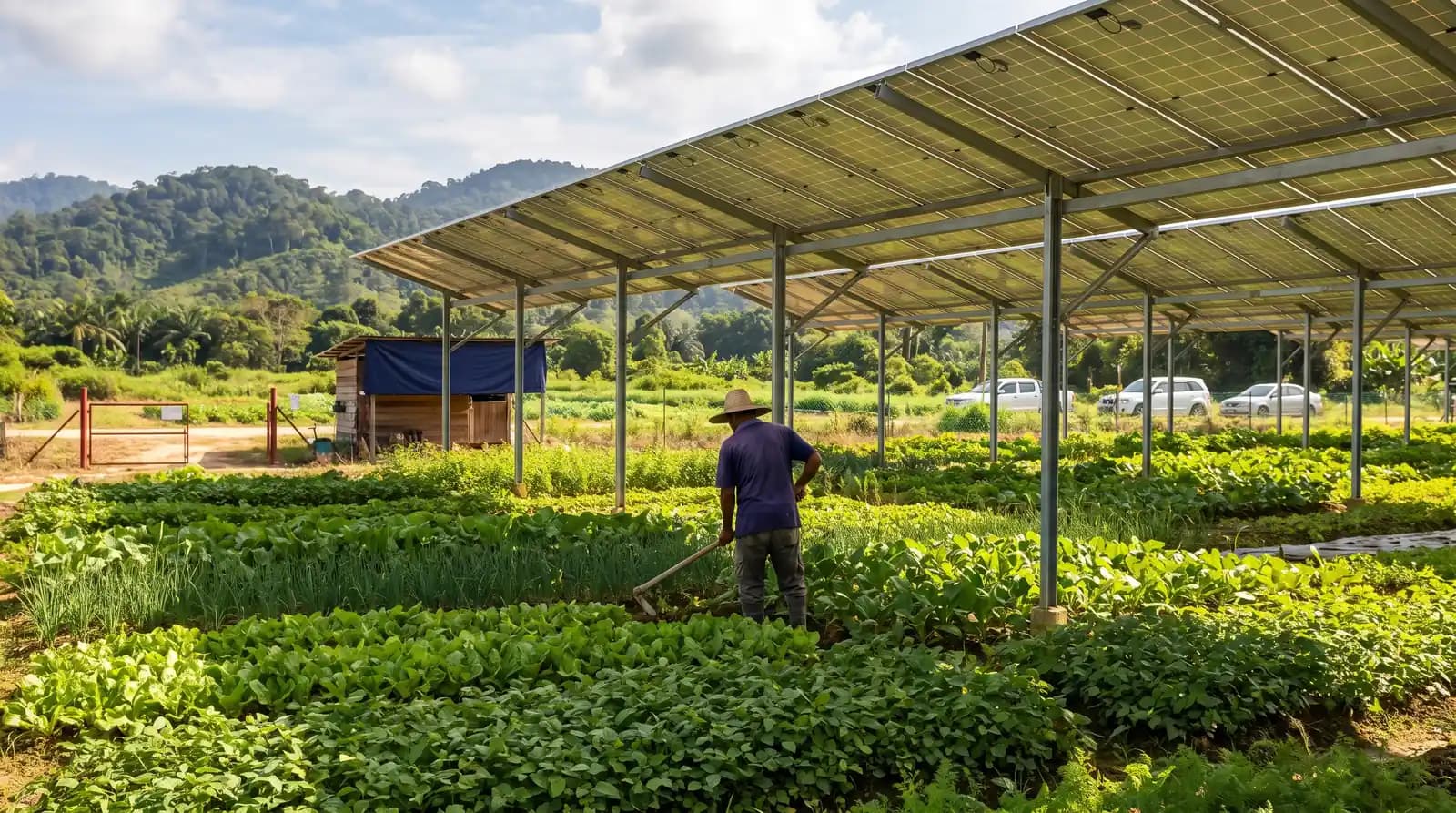
What Is Agrivoltaics?
Agrivoltaics — also called agrophotovoltaics (APV) — is the simultaneous use of land for both solar power generation and agricultural production. Developed in Germany in 1982 and now deployed across Japan, South Korea, France, and the United States, agrivoltaics is at an early stage in Malaysia.
The core principle: elevated solar panels (mounted 2–4m above ground) allow agricultural activity to continue beneath, while the panels themselves generate clean electricity. Malaysia's high solar irradiance (about 1,260 kWh/kWp/year) combined with the tropical need for shade creates a natural fit.
30–50% shade from elevated panels reduces heat stress on shade-tolerant crops. Water evaporation can drop (site-dependent), lowering irrigation needs during Malaysia's dry spells.
Solar produces value (bill savings from self-consumption under Solar ATAP, or rent from leasing land to a solar developer) alongside crop/livestock/aquaculture revenue — on the same acre.
Overseas studies report that agrivoltaics can improve overall land productivity (a Land Equivalent Ratio above 1) for some shade-tolerant crops, because the same land produces both crops and energy. Results vary by crop and site.
Types of Agrivoltaics in Malaysia
Malaysia's agricultural diversity — from paddy fields to aquaculture ponds, palm oil estates to cattle ranches — creates multiple agrivoltaic configurations suited to different land types.
Fishvoltaics
Solar panels mounted over aquaculture ponds. The shade can lower water temperature, limit algae growth, and reduce evaporation (indicative, site-dependent). Fish — particularly catfish (keli), tilapia, and shrimp — grow faster in cooler, more stable conditions. Already deployed in Kedah and Perak.
Cowvoltaics
Elevated solar arrays over grazing pasture. The shade reduces heat stress on cattle — a major productivity issue in tropical Malaysia. Cattle under panels can show improved milk production and weight gain (indicative, site-dependent). Grass grows more evenly with partial shade.
Crop-Solar Integration
The classic agrivoltaic model: elevated panels (2–4m) over crop rows. Shade-tolerant vegetables, herbs, and root crops grow beneath. Best for smallholders and FELDA settlers who can intercrop high-value specialty crops under their existing land. Requires no land category conversion if panels remain elevated and agriculture continues below.
Agroforestry Solar
Panels installed between rows of fruit trees or timber species. Works well with banana, papaya, starfruit, and young rubber or palm before canopy closure. The trees eventually provide additional shade management. Long-term land value appreciation alongside energy income.
Crops That Grow Well Under Solar Panels in Malaysia
Not all crops benefit equally from partial shade. The following compatibility chart is indicative, drawing on overseas agrivoltaic studies; no Malaysian trial data is published here.
| Crop | Optimal Shade | Agrivoltaic Benefit | Yield Impact | Notes |
|---|---|---|---|---|
| 🍄Mushrooms | 80–100% | Excellent | Possible gain (overseas studies) | A strong agrivoltaic crop in Malaysia. Needs shade. Premium prices RM12–25/kg (illustrative assumption). Shiitake, oyster, king oyster all viable. |
| 🌶️Chili Padi | 30–50% | Very Good | Possible gain (overseas studies) | Shade reduces fruit drop and sunscald. Higher moisture retention improves yield in dry season. |
| 🌿Pegaga / Centella | 40–60% | Excellent | Possible gain (overseas studies) | High-value medicinal herb. Naturally shade-preferring. Export demand from Korea and Japan. RM8–15/kg. |
| 🫚Ginger & Turmeric | 30–50% | Good | Possible gain (overseas studies) | Root crops that naturally grow under forest canopy. Shade reduces bolting. Domestic and export demand steady. |
| 🥬Kangkung / Sawi | 20–40% | Good | Neutral to possible gain | Fast-growing leafy vegetables. Partial shade extends harvest window and reduces bolting in hot months. |
| 🌾Lemongrass | 20–30% | Moderate | Neutral to possible gain | Low maintenance, multi-cut harvest. Used in essential oil extraction. Popular for biogas co-product. |
| 🌾Rice (Padi) | 0–10% | Not Suitable | Yield likely to fall under shade | Full-sun crop. Shade above 10% significantly reduces grain yield. Not recommended for agrivoltaic integration. |
| 🌽Corn / Maize | 0–10% | Not Suitable | Yield likely to fall under shade | C4 photosynthesis crop requiring maximum sunlight. Yield loss is significant under panels. |
Indicative only, based on overseas studies; no Malaysian trial data is published here. Yield effects vary by microclimate, soil, and management.
Mushroom cultivation under solar panels is one of the higher-value agrivoltaic applications in Malaysia. Shiitake and oyster mushrooms require 80–100% shade, making the solar panel canopy ideal. A 1,000 sq ft agrivoltaic mushroom house can yield 200–400kg/month at RM12–25/kg — generating RM2,400–10,000/month in agricultural income alongside solar generation. Investment in mushroom substrate and spawn: RM8,000–15,000/setup.
Dual Income Projection Calculator
Estimate your combined solar + agricultural income based on land size and agrivoltaic type. Figures are illustrative estimates based on Malaysian market rates (2026).
Illustrative third-party market estimates, not Trexon prices or offers. Indicative only. Actual income depends on location, solar resource, crop yield, market prices, the TNB tariff and any land-lease terms.
Agrivoltaics for FELDA Settlers
FELDA settlers managing palm oil smallholdings (typically 10–30 acres) are among the best-positioned Malaysians to benefit from agrivoltaics. The combination of large land areas, existing agricultural infrastructure, and the need to supplement palm oil income during commodity price dips makes the economics compelling.
Illustrative. Based on CPO price RM3,500–4,000/tonne, solar value from land-lease or revenue-share terms, and agrivoltaic crop revenue. Actual figures vary.
FELDA settlers on Hak Milik Sementara (HMS) land need FELDA's approval before proceeding. Full title holders can approach solar developers directly.
Three options: (A) Roof/Land Lease — a third-party developer pays rent, terms negotiated per site, no capital from you. (B) Revenue Share — a third-party developer funds the installation and shares income. (C) Full ownership — finance through your bank and own the asset. Lease and revenue-share terms are third-party arrangements, not Trexon offerings.
Maintain your palm oil, rubber, or crop production below the panels. This is non-negotiable for land category compliance and to retain DOA agricultural support schemes.
Under the land-lease model, the developer handles all SEDA and TNB registrations. Under ownership models, your installer handles the Solar ATAP application; land-use approvals stay with the landowner.
For Plantation Owners: Integration Options
Large-scale plantation operators (rubber, palm oil, banana, pineapple) can integrate solar at multiple points — from estate perimeters and buffer zones to inter-row spacing — without disrupting core production.
Inter-Row Solar
Panels mounted between tree rows (for rubber, young palm oil). Works during the early years before canopy closure. System can be relocated as trees mature.
Perimeter + Buffer Zone Solar
Install panels on estate perimeters, road margins, and buffer zones without affecting core production areas. Lower installation complexity, with no direct shading of crop areas.
Estate Building Rooftop Solar
Solar panels on mill buildings, worker housing, processing facilities, and estate offices. Self-consumption model reduces TNB bills for estate operations.
Degraded Land Rehabilitation
Convert unproductive degraded plantation land (too eroded, flooded, or infertile for crops) to solar generation while beginning soil rehabilitation through shade and vegetation below panels.
Regulatory Guide: Solar on Agricultural Land
Installing solar on agricultural land in Malaysia involves multiple regulatory touchpoints across state land offices, SEDA, the Energy Commission, and the Department of Agriculture. Here is the step-by-step pathway.
Malaysia's land law is a state matter (National Land Code administered by states). What is acceptable in Selangor may require full conversion in Kelantan. Always get written PTG confirmation before committing capital.
Verify current land category (agricultural, industrial, etc.). For true agrivoltaics where farming continues below, most states do not require conversion. Get written confirmation from PTG before any investment.
Grid-connected solar must be installed by a SEDA-registered PV service provider (RPVSP). On-site systems connect under Solar ATAP (self-consumption; non-domestic premises capped at 100% of the site's maximum demand (MD) in kWac, with a ceiling of 1,000 kWac); utility-scale plants that sell power go through the Energy Commission's LSS programme.
Required for generation capacity above 1MW (and for selling electricity to third parties at any scale). The Electricity Supply Act requires an EC license for commercial generation. For smaller systems under Solar ATAP, the application is submitted by an RPVSP through SEDA.
Environmental Impact Assessment required for solar installations above 50MW or those near sensitive ecosystems (mangroves, forest reserves, wildlife corridors). Most agrivoltaic projects under 50MW do not require full EIA — a Preliminary EIA (PEIA) may suffice.
Register your crop/livestock operation with DOA to maintain agricultural land status and access government agricultural support schemes, fertiliser subsidies, and insurance programmes. This also strengthens your case with the land office that agricultural use is continuing.
Apply for grid connection with TNB. Required for grid-tied systems. TNB will evaluate your interconnection request, specify technical requirements, and sign a Connection Agreement. Timeline varies by state and connection voltage level.
Frequently Asked Questions
Ready to Explore Agrivoltaics for Your Land?
Trexon Energy designs and installs grid-connected solar for farm buildings and on-site loads under Solar ATAP. Send us your TNB bills and site details for a free quote.