Model your project savings and peak-demand reduction
Calculate ROIClean Clothes,
Cleaner Energy
Industrial washers, dryers, and pressing equipment make laundry services extremely energy-intensive. Solar cuts costs on your biggest expense.
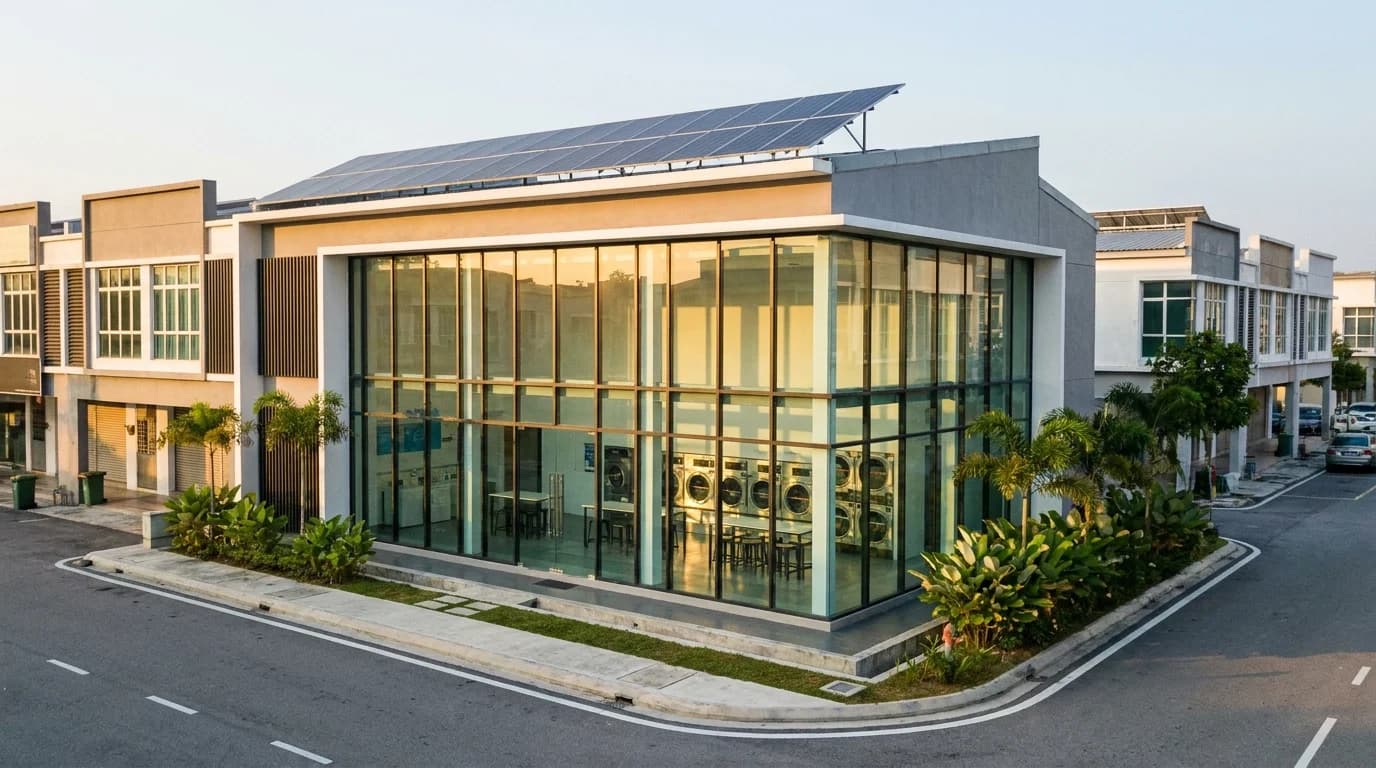
Why Laundries Are Going Solar
Energy is one of your largest operating costs. Solar turns part of that cost into savings.
Industrial Dryers
❌ Heavy-duty dryers running constantly, massive power draw
✅ Solar offsets a share of daytime drying costs
Washing Machines
❌ Industrial washers with hot water cycles all day
✅ Solar powers washers plus water heating
Pressing & Ironing
❌ Steam presses and irons consume substantial energy
✅ Daytime solar power for pressing equipment
Ventilation Systems
❌ Exhaust fans, AC needed for heat and humidity control
✅ Offsets part of your climate-control cost
Long Operating Hours
❌ 6am-10pm operations = high electricity use
✅ Solar covers the daytime part of your operating hours
Razor-Thin Margins
❌ Energy is a major operating cost
✅ Reduce your largest expense and improve margins
Solar Solutions by Laundry Size
Small Laundromat
Mid-Size Laundry
Large Commercial Laundry
Industrial Facility
Spin Cycle Savings Into Profit
Example: 19.84 kWp Catalogue System for a Laundry
Why Malaysian Laundries Choose Solar
Leverage Malaysia-specific incentives and overcome local energy challenges
Solar ATAP for Laundries
- ✓Export credit at the monthly Average SMP under Solar ATAP; unused credit is forfeited at the end of each billing period
- ✓TNB tariff exposure: Lower exposure to TNB tariff increases on the energy your system generates
- ✓SEDA support: Solar ATAP documentation prepared by Trexon
Malaysian Climate Advantage
- ✓About 3.5 peak sun hours daily: Consistent tropical generation
- ✓Good alignment: Peak generation overlaps busy laundry hours
- ✓Year-round production: No winter drop-off like temperate zones
Related Solar Solutions
Explore solar options for other business types
Frequently Asked Questions
Common questions from laundry business owners about solar energy
How much energy do commercial laundry dryers and washers actually consume?
Commercial laundry equipment is among the most energy-intensive in any business. A single industrial dryer (20–30 kg capacity) draws 10–15 kW continuously, while a commercial washer uses 3–7 kW per cycle plus hot water heating. A typical coin laundry with 10 washers and 8 dryers running simultaneously consumes 80–120 kW at peak — equivalent to a small factory floor. Multiply this by 12–16 operating hours daily, and a mid-size laundromat easily racks up RM 5,000–12,000 per month in TNB bills before solar.
What solar system size is right for a coin laundry in Malaysia?
A typical coin laundry with 8–12 machines (combined load 40–80 kW) needs a 30–60 kWp solar system costing RM 72,000–144,000 + SST, saving about RM 1,600–3,200 per month. Under Solar ATAP, excess solar generation during quieter midday periods earns credits to offset peak morning and evening usage. We recommend sizing the solar system to cover 70–80% of your average daytime load — not the peak — to maximise the value of every ringgit invested. Our free quote includes a load-profile analysis based on your actual TNB bills.
Can solar thermal water heating work for laundry businesses?
Solar thermal is highly effective for laundries, where hot water for wash cycles accounts for 20–30% of total energy costs. A solar thermal system is not a Trexon product; market estimates of RM 15,000–40,000 are indicative only, not a Trexon quote, and it can supply 60–80°C water for industrial washers, reducing electric water heating costs by 65–80%. A hybrid approach is common: solar PV panels for electrical loads (dryers, lighting, AC) plus solar thermal collectors for hot water. The combined saving depends on your machines and operating hours, and is modelled from your bills.
What is the ROI calculation for a laundry business going solar?
Laundries have one of the faster solar paybacks among commercial businesses because energy costs are high relative to revenue. For example, a 60 kWp system costs about RM 144,000 + SST (RM 152,640 with 6% SST). If all output is used on site at the Non-Domestic Low Voltage rate of RM 0.5068/kWh, it saves about RM 3,200 a month (about RM 38,300 a year), a payback of about 3.8 years (about 4.0 years with SST). Total 25-year savings are about RM 0.91 million. The GITA Asset allowance of 60% (RM 86,400) set off against statutory income is worth about RM 20,700 in tax at the 24% corporate rate once fully absorbed. The system must be commissioned and the application submitted to MGTC by 31 December 2026; subject to MGTC verification.
How much energy does a commercial washing machine use compared to household units?
Commercial washers are significantly more energy-intensive than household units. A standard household washer uses 0.5–1.5 kWh per cycle. A commercial front-loader (15–25 kg capacity) uses 3–8 kWh per cycle including water heating, running 6–10 cycles per day. At the Non-Domestic Low Voltage rate of RM 0.5068/kWh, a single commercial washer costs about RM 9–40 per day to operate — RM 280–1,200 per month per machine. With solar, daytime cycles run largely on your own generation, improving the economics of each wash cycle.
Get a Custom Solar Proposal for Your Laundry Business
Tell us about your business and we'll design a solar system that matches your energy needs and budget.
- Sizing from your 12 months of TNB bills and shift pattern
- Roof, switchboard and single-line diagram reviewed by our engineers
- Available incentives (GITA for solar, subject to MGTC verification) and Solar ATAP eligibility checked for your premises
- SEDA-registered PV Service Provider (RPVSP-2026/373) · SSM 201301044881 (1074704-D)
Prefer to talk first? Message our commercial team on WhatsApp.
WhatsApp Us