Peak Shaving for Malaysian Industrial Parks: How Factories in BKIP, SAC, and Kulim Reduce MD Charges
Ringkasan Eksekutif (Executive Summary)
- • Caj Maximum Demand (MD): Bayaran kVA/kW TNB bagi industri/komersial boleh mencecah 30% ke 50% daripada bil elektrik bulanan.
- • Teknik Peak Shaving: Menyahcas bateri BESS (Lithium LFP) semasa tempoh beban puncak untuk menghadkan draw elektrik TNB di bawah had tertentu.
- • Penjimatan Purata: Antara RM20,000 sehingga RM50,000 sebulan bagi kilang bersaiz sederhana di BKIP, Senai (SAC), atau Kulim (KHTP).
- • Gred Insentif Cukai: Layak mendapat tuntutan 100% GITA (Green Investment Tax Allowance) yang mengimbangi 14.4% kos modal permulaan.
For commercial and industrial (C&I) companies operating inside Malaysia's premier manufacturing zones like Batu Kawan Industrial Park (BKIP), Senai Airport City (SAC), and Kulim Hi-Tech Park (KHTP), electricity bills are often the second largest operating expense after raw materials.
Under TNB's unbundled tariff structure, businesses are heavily penalized not just for the total kilowatt-hours (kWh) they consume, but for their highest 30-minute peak energy draw in a billing month. This is known as the Maximum Demand (MD) charge. Combined with rising ICPT surcharges, high MD penalties act as a severe financial drain on factories.
By combining high-performance solar PV installations with modular Battery Energy Storage Systems (BESS) for peak shaving, factory managers are reclaiming control of their energy load profiles.
Understanding TNB Maximum Demand (MD) Penalties
TNB commercial and industrial tariffs (e.g., C1, C2, E1, E2, E3) include a Maximum Demand charge calculated as RM per kW (or kVA) per month. For example, under Tariff E2 (Medium Voltage Industrial), the demand charge is RM37.00 per kW. For Tariff C2 (Medium Voltage Commercial), it peaks at RM45.10 per kW.
If a factory experiences a temporary power draw spike of 1,500 kW for just 30 minutes (due to starting up heavy CNC machinery, chillers, or conveyors simultaneously), the facility is billed for that peak level for the entire month. At RM37.00/kW, that single peak costs RM55,500 in demand charges alone, even if the factory average load is only 800 kW.
TNB Tariff MD Charges Breakdown (2026)
| Tariff Category | Voltage Level | MD Rate (RM/kW/mo) | Peak kWh Rate (sen) | Off-Peak kWh Rate (sen) |
|---|---|---|---|---|
| Tariff C2 (Commercial) | Medium Voltage | RM 45.10 | 36.50 | 22.40 |
| Tariff E1 (Industrial Flat) | Medium Voltage | RM 30.30 | 33.70 (Flat) | 33.70 (Flat) |
| Tariff E2 (Industrial Peak/Off-Peak) | Medium Voltage | RM 37.00 | 35.50 | 21.90 |
| Tariff E3 (High Voltage Heavy) | High Voltage | RM 35.50 | 33.70 | 20.20 |
How Battery Storage (BESS) Solves Peak Demand
A Battery Energy Storage System (BESS) acts as a high-capacity electrical buffer. The peak shaving process operates on a daily automated cycle managed by an Energy Management System (EMS):
- Off-Peak Charging: The BESS charges overnight (between midnight and 7:00 AM) when electricity rates are at their lowest (e.g., 21.90 sen/kWh under Tariff E2), or during mid-day when solar panels generate excess power that exceeds the immediate factory load.
- Real-Time Monitoring: The EMS continuously tracks the facility's load draw. The manager sets a target MD threshold (for example, 1,000 kW).
- Active Peak Shaving (Discharge): When production lines ramp up and the load draw approaches 1,010 kW, the BESS instantly discharges stored battery energy. The battery covers the excess draw, ensuring the draw from the TNB grid never crosses the 1,000 kW ceiling.
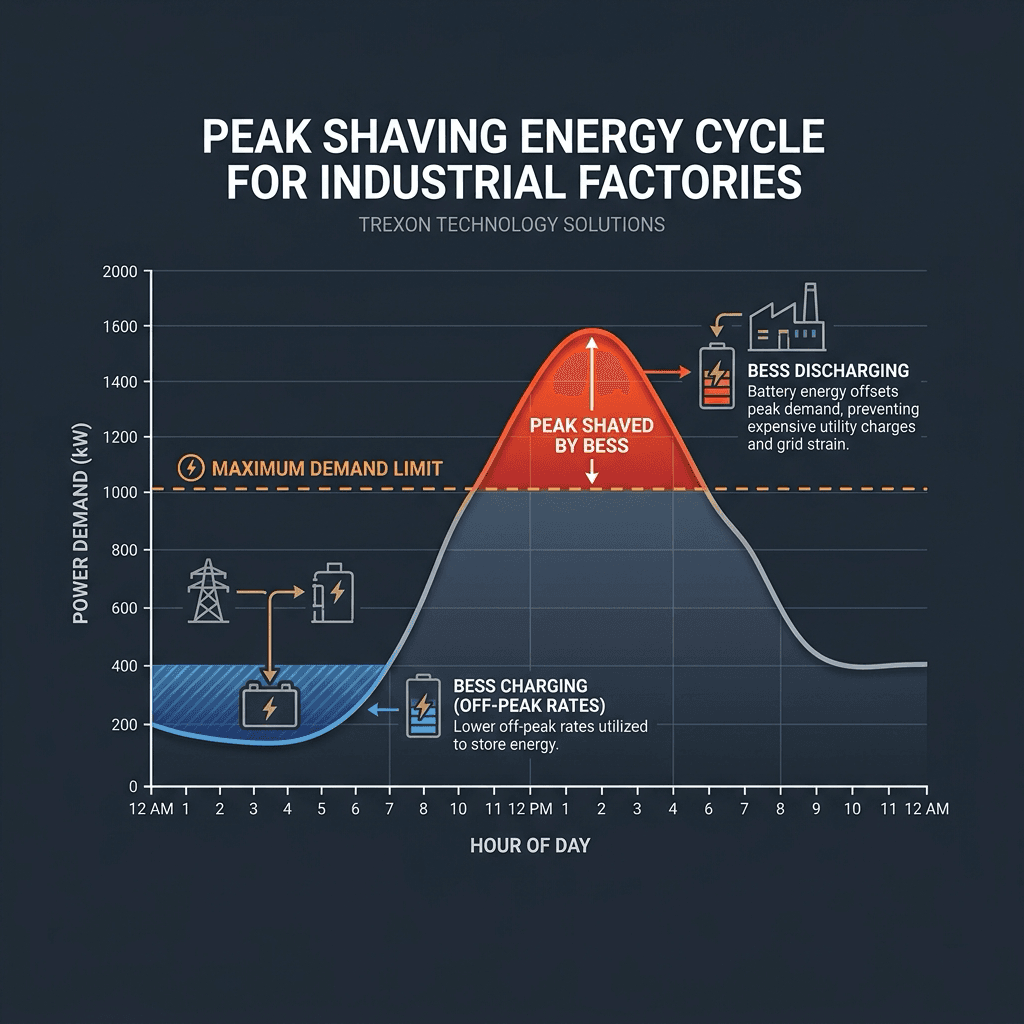
"By keeping the grid draw flat, the recorded monthly Maximum Demand is locked at a lower tier, saving tens of thousands in utility charges."
Case Study: 300kW / 600kWh Peak Shaving in Batu Kawan (BKIP)
In a recent implementation at an electronics packaging supplier in Batu Kawan Industrial Park, Penang:
- Prior Peak MD: 1,250 kW (Average Monthly bill: RM72,000)
- BESS Solution: 250 kW / 500 kWh Liquid-Cooled LFP Storage
- Programmed Threshold: 900 kW (A target shaving of 350 kW)
- MD Billing Reductions: Saved 350 kW × RM37.00 = RM12,950 per month in Maximum Demand charges.
- Arbitrage Benefits: Storing 400 kWh of solar/off-peak energy and discharging during peak hours saved an additional RM1,850 per month.
- Total Savings: RM14,800/month (RM177,600/year).
With a total system CAPEX of RM675,000, and a GITA tax deduction of RM97,200 (100% Investment Tax Allowance at 24% corporate tax), the net CAPEX was RM577,800. The payback period was completed in 3.9 Years, with the battery warrantied for 15 years (6,000 cycles).
Solar Panel Untuk Kilang: Bahasa Malaysia Context
Bagi pengusaha kilang tempatan, pemasangan solar panel untuk kilang bukan sahaja mengurangkan caj Maximum Demand, tetapi ia turut disokong oleh inisiatif kerajaan persekutuan melalui skim Net Energy Metering (NEM NOVA) dan insentif cukai GITA.
Melalui skim NEM, tenaga solar yang dijana pada waktu siang akan menyara operasi kilang secara terus. Sebarang lebihan elektrik boleh dieksport semula ke grid TNB sebagai kredit bil untuk bulan berikutnya. Apabila digabungkan dengan sistem bateri, lebihan tenaga solar ini boleh disimpan untuk menyokong operasi kilang pada waktu malam, atau digunakan semasa waktu puncak bagi mengelakkan caj Maximum Demand yang tinggi.
Is Peak Shaving Right for Your Factory?
Peak shaving provides the highest return on investment for facilities that display the following characteristics:
- High Peak-to-Average Load Ratio: Facilities where peak energy spikes are significantly higher than the average constant baseload.
- TNB Tariffs E2, E3, or C2: Tariffs that enforce peak and off-peak energy rates, which maximize both demand charge shaving and energy arbitrage.
- Strict Carbon (ESG) Targets: Companies looking to phase out carbon-heavy backup diesel generators in favor of clean BESS backups.
Get a Custom Peak Shaving Audit
Trexon Energy engineers custom BESS designs based on your actual 12-month interval data. Contact us to receive a detailed ROI simulation for your facility roof.